
The court charges $338 to file a Chapter 7 case and $313 to file a Chapter 13 case. Those totals have applied since 1 December 2023, and a married couple filing one joint case pays them once. You can ask to pay in up to four instalments. In Chapter 7 only, you can ask the court to waive the fee if your family’s income is under 150% of the federal poverty guideline and you can’t pay even in instalments. You also take two required courses, where a fee of $50 or less is presumed reasonable and people under the same 150% line are presumed entitled to a waiver or reduction. A lawyer, if you hire one, is a separate cost that no court fee covers. No public national dataset of bankruptcy lawyer fees exists, so this page gives the rules that govern those fees rather than an average.
This page is general information, not legal, tax or financial advice, and not a substitute for the advice of an attorney. Bankruptcy law and exemption amounts vary by state and change. Ask a bankruptcy lawyer, legal aid or the court about your situation.
This page is part of our Should You File? guide. It lists each cost, the rule that sets it and where the rule is published. It can’t tell you which chapter suits you or whether to file; the rules that bear on that are in how Chapter 7 and Chapter 13 differ.
The court fee, piece by piece
The filing fee has up to three parts. Congress sets the main fee in 28 U.S.C. 1930(a)(1). The Judicial Conference of the United States adds the other two in the Bankruptcy Court Miscellaneous Fee Schedule, which has been in force since 1 December 2023.
| Part | Chapter 7 | Chapter 13 | Where it comes from |
|---|---|---|---|
| Statutory filing fee | $245 | $235 | 28 U.S.C. 1930(a)(1) |
| Administrative fee | $78 | $78 | Fee schedule, item 8 (since 1 Dec 2023) |
| Trustee surcharge | $15 | none | Fee schedule, item 9; 11 U.S.C. 330(b)(2) |
| Total at filing | $338 | $313 | Our addition of the parts |
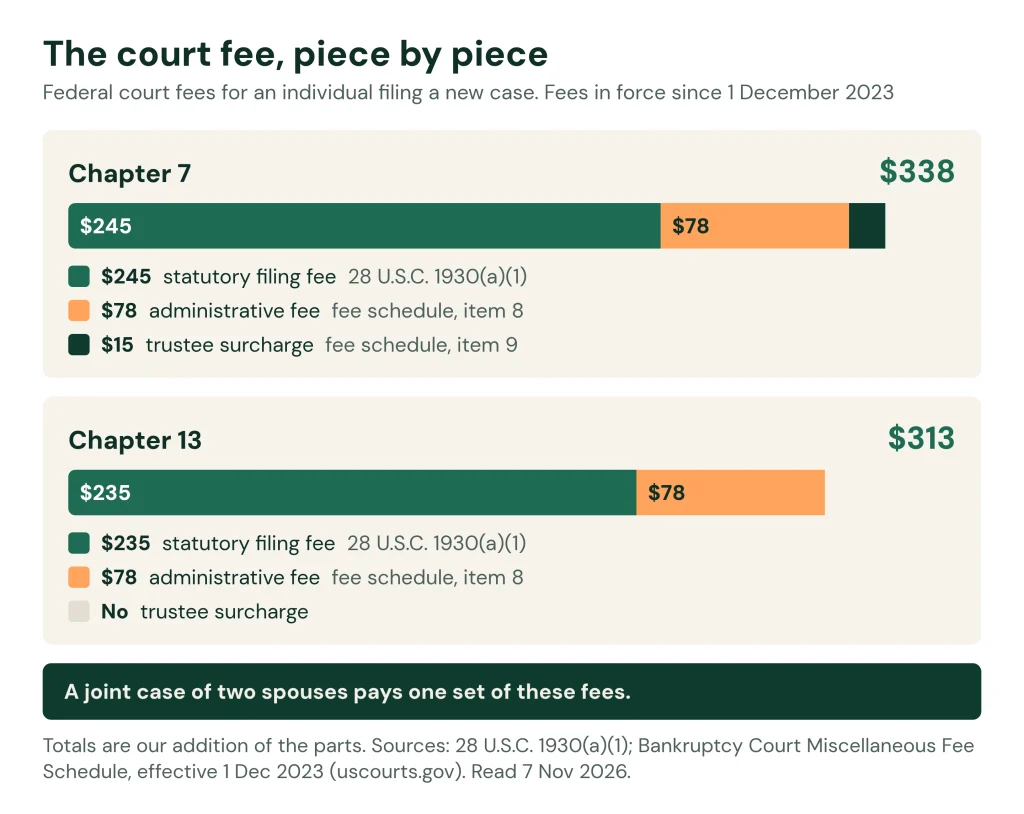
The courts’ own instructions for individual filers (April 2025), in the part on the fee waiver form, give the same total: “The fee for filing a bankruptcy case under chapter 7 is $338.” The court’s checklist of required filings and fees (Form 2000, updated 1 December 2025) shows the same parts for each chapter. According to the uscourts.gov basics pages, a joint petition pays only one filing fee, one administrative fee and, in Chapter 7, one surcharge.
You may see $335 and $310 on other sites. Those totals use the old $75 administrative fee and have been out of date since 1 December 2023. The Chapter 7 and Chapter 13 basics pages on uscourts.gov still said $75 when we read them on 7 November 2026. The fee schedule is the document that sets the fee, and it says $78.
Part of a Chapter 7 fee goes to the trustee, the person the US Trustee Program appoints to run the case. In cases filed on or after 1 October 2026 under Chapter 7, or filed then under another chapter and later converted to Chapter 7, the trustee is paid $105 out of the $245 once the work is done (11 U.S.C. 330(b)(1), as amended by Pub. L. 119-76). Before that date the amount was $45. The trustee also receives the $15 surcharge (330(b)(2)). The change comes out of the existing fee, so the amount you pay is still $338.
Paying in instalments
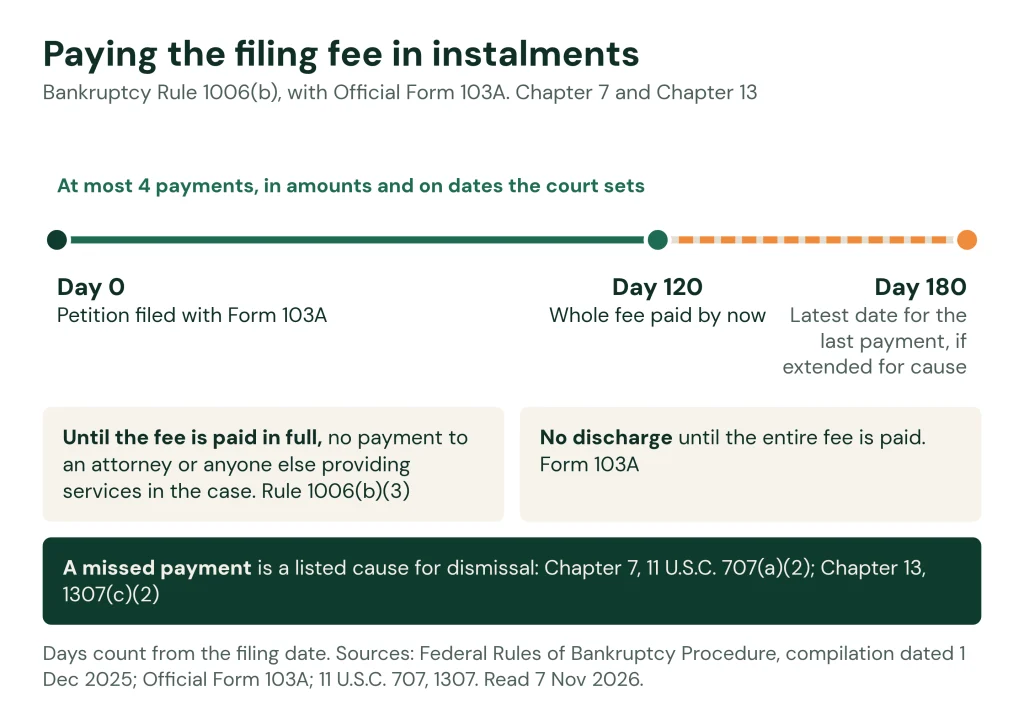
Under Bankruptcy Rule 1006(b), an individual can file without paying anything up front if the petition comes with a signed Application for Individuals to Pay the Filing Fee in Installments (Official Form 103A). This works in both Chapter 7 and Chapter 13. The clerk must accept the petition. The rules for instalments are:
- At most four payments, in amounts and on dates the court sets before the meeting of creditors. The court can also order the whole fee paid at once.
- Everything paid within 120 days after filing. For cause, the court can extend an instalment, but the last one must be paid within 180 days.
- Other payments wait. Until the fee is paid in full, you and any Chapter 13 trustee must not pay an attorney or anyone else who provides services in connection with the case (Rule 1006(b)(3)).
- No discharge before the fee is paid. The discharge is the court order that ends your personal liability for the debts it covers. Form 103A says your debts won’t be discharged until the entire fee is paid.
- A missed payment puts the case at risk. Unpaid fees are a listed cause for dismissing a case, in Chapter 7 under 11 U.S.C. 707(a)(2) and in Chapter 13 under 1307(c)(2), where the court can instead convert the case to Chapter 7. Form 103A also warns that a missed payment can affect your rights in other bankruptcy proceedings.
According to Form 2000, the $78 administrative fee and the $15 surcharge can also be paid in instalments if the court grants your request.
The fee waiver: Chapter 7 only
28 U.S.C. 1930(f)(1) lets the court waive the Chapter 7 filing fee for an individual whose income is less than 150% of the official poverty line for a family of that size and who is unable to pay the fee in instalments. Both conditions must be met. You apply with the Application to Have the Chapter 7 Filing Fee Waived (Official Form 103B), filed with the petition. The court then grants it, denies it with a payment schedule, or sets a hearing.
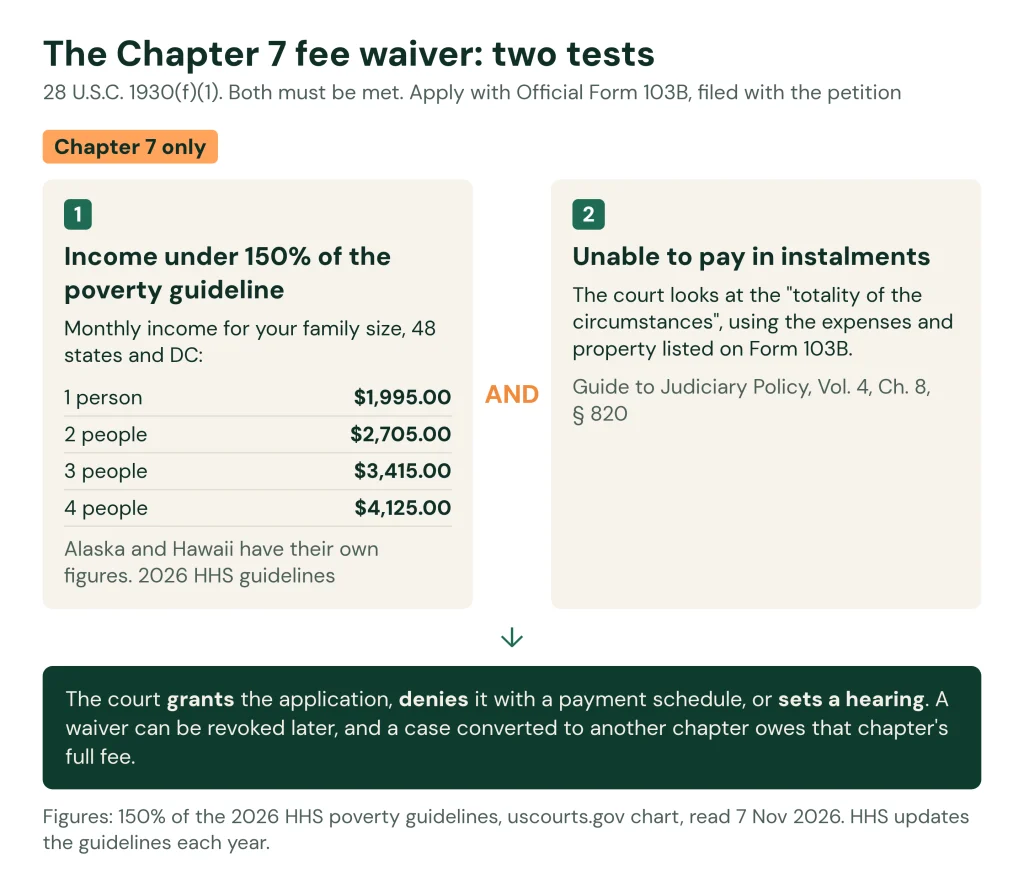
The Judicial Conference publishes the procedures courts use to apply this test, in the Guide to Judiciary Policy, Vol. 4, Ch. 8, § 820:
- Which poverty line: the poverty guidelines from the Department of Health and Human Services (HHS). Alaska and Hawaii have their own figures. Puerto Rico and the other territories may use the figures for the 48 states.
- Income: the “total combined monthly income” reported on Schedule I, minus any non-cash government assistance (Form 103B gives food stamps under SNAP and housing subsidies as examples). Form 103B asks for each person’s average monthly net income, meaning take-home pay.
- Family: you, your spouse and the dependents listed on Schedule I. A spouse is left out if you are separated and not filing together.
- Instalments: the court looks at the “totality of the circumstances” to decide whether you can pay in instalments.
- Paying a lawyer doesn’t rule you out. The procedures say a debtor may qualify even after paying, or promising to pay, an attorney, a petition preparer or a debt relief agency. Form 103B still asks about every such payment.
- What a waiver covers: the $245, the $78 and the $15. The court may also waive later fees in the case, at its discretion.
- A waiver can be undone. The court can revoke it if later developments show it wasn’t warranted. If the case is converted to another chapter, the full fee for that chapter is due.
The courts publish a chart of 150% of the 2026 HHS poverty guidelines, which match the 2026 guidelines on the HHS site. Form 103B asks for monthly figures, so the monthly column is the one to compare.
| People in the family | 48 states and DC, monthly | Alaska, monthly | Hawaii, monthly | 48 states and DC, a year |
|---|---|---|---|---|
| 1 | $1,995.00 | $2,493.75 | $2,295.00 | $23,940 |
| 2 | $2,705.00 | $3,381.25 | $3,111.25 | $32,460 |
| 3 | $3,415.00 | $4,268.75 | $3,927.50 | $40,980 |
| 4 | $4,125.00 | $5,156.25 | $4,743.75 | $49,500 |
| 5 | $4,835.00 | $6,043.75 | $5,560.00 | $58,020 |
| Each extra person | +$710.00 | +$887.50 | +$816.25 | +$8,520 |
Worked example (made up, for the arithmetic only): a family of three in Ohio, two adults and one child, with combined take-home pay of $3,200 a month and no non-cash benefits. $3,200 is below $3,415, so the income part of the test is met. The second part, whether this family can pay $338 in up to four payments over 120 days, is for the court to decide from the expenses and property listed on Form 103B. At $3,500 a month the same family would be over the line, so the income part of the test would not be met, and the fee would be due in full or in instalments. This example shows the arithmetic only. It doesn’t predict what a court would decide.
Section 1930(f)(1) allows the waiver only in Chapter 7 cases, and Form 103B is a Chapter 7 form. A Chapter 13 filer can still use instalments. For more on starting a Chapter 7 case on a tight budget, see filing Chapter 7 with no money.
The two courses
Bankruptcy requires two courses. The first is a credit counselling briefing from an approved agency, taken in the 180 days before you file (11 U.S.C. 109(h), with narrow exceptions). The second is a debtor education course, or personal financial management course, taken after you file and, with limited exceptions, required for the discharge. Each one has a fee, and both fees are governed by US Trustee rules:
- $50 or less is presumed reasonable for each course. A provider that wants to charge more needs the US Trustee’s approval first (28 CFR 58.21(a) and 58.34(a)).
- A fee waiver for people who can’t pay. The provider must waive the fee in whole or in part when you can’t pay it. A household income under 150% of the poverty guidelines (the table above) is presumed to mean you can’t pay. The provider can rebut that presumption and charge a reduced fee (58.21(b), 58.34(b)).
- All fees stated up front. A provider may charge a separate fee for the certificate, but it must disclose every fee before the session starts. It must also provide the course and the certificate whatever your ability to pay, according to the US Trustee’s credit counselling FAQ and debtor education FAQ (both updated 15 January 2025).
Take each course from a provider on the US Trustee’s lists of approved credit counselling agencies and approved debtor education providers. The US Trustee Program says in its FAQs that it does not recommend any particular agency or provider or guarantee the quality of their services. We don’t recommend any provider either. In Alabama and North Carolina, cases come under a Bankruptcy Administrator rather than the US Trustee, and the UST list page sends questions there. Timing and certificates are covered in the two required courses.
Lawyer fees: the rules, not an average
No government body publishes a national dataset of what bankruptcy lawyers charge. The averages and ranges you’ll see on other sites come from law firms, lenders and filing services. We haven’t been able to check them against a primary source, so we don’t repeat them. What we can give you is the set of rules that apply to these fees:
- A written contract. A “debt relief agency” is anyone paid to give bankruptcy assistance to an “assisted person”, with listed exceptions such as 501(c)(3) nonprofits; the definition does not exclude lawyers (11 U.S.C. 101(12A)). An assisted person is someone whose debts are mainly consumer debts and whose nonexempt property is worth less than $256,800 (101(3), as adjusted from 1 April 2025 by 90 F.R. 8941). Within 5 business days after it first gives you bankruptcy assistance, and before your petition is filed, a debt relief agency must sign a written contract with you. The contract must explain clearly the services, the fees and the terms of payment, and you get a copy (11 U.S.C. 528(a)).
- The fee goes on the court record. Your lawyer must file a statement of everything you paid or agreed to pay in the year before filing, and where the money came from (11 U.S.C. 329(a)). Under Rule 2016(b), the statement is due within 14 days after the order for relief (in a case you file yourself, the filing date) and goes to the US Trustee as well. Any later payment needs a supplemental statement within 14 days.
- The court can cut an excessive fee. If the fee exceeds the reasonable value of the services, the court can cancel the agreement or order the money returned (329(b)).
- Chapter 13 fees can be paid through the plan. In a Chapter 12 or 13 case of an individual, the court may allow reasonable pay to the debtor’s attorney (330(a)(4)(B)). The trustee pays unpaid administrative claims of this kind before or alongside each payment to creditors (1326(b)(1)).
Some bankruptcy courts publish a presumptively reasonable (“no-look”) Chapter 13 fee. A lawyer who charges no more than that amount doesn’t have to file a detailed fee application. Two examples follow. They apply only in those districts, and each court can adjust the amount in a particular case:
| District | Presumptive Chapter 13 fee | Applies to | What it covers |
|---|---|---|---|
| Western District of Wisconsin | $5,500 ($6,000 with the court’s mortgage modification mediation) | Cases filed on or after 1 May 2024 | Through at least plan confirmation, costs included, filing fee not included (court’s no-look fee notice) |
| Northern and Southern Districts of Mississippi | Up to $4,600 | Cases filed on or after 1 May 2025 | Before and after confirmation, adversary proceedings not included. Filing fee, credit report charge and credit counselling fee are extra (Amended Standing Order 2025-02) |
A bankruptcy petition preparer is someone other than your lawyer (or the lawyer’s supervised staff) who prepares bankruptcy documents for filing for pay (110(a)(1)). Preparers are not allowed to give legal advice, including on which chapter to choose or what property you can keep (11 U.S.C. 110(e)(2)). They also may not take your court filing fee (110(g)): that goes to the court. A preparer must file a sworn declaration with your petition listing the fees received from you in the 12 months before filing (110(h)(2)). The court must disallow any fee that exceeds the value of the services or breaks a maximum set under court rules or guidelines, and order it turned over to the trustee (110(h)(3)). If you plan to file on your own, read filing Chapter 7 without a lawyer first.
Free legal help exists. Legal aid offices, law school clinics, volunteer lawyer programmes and some bankruptcy courts’ self-help pages work with people who can’t pay a lawyer. Your bankruptcy court’s website or clerk’s office can tell you what your district offers.
Chapter 13: the trustee’s percentage
In Chapter 13 you pay a monthly amount to a standing trustee, who pays your creditors under the plan. Each payment includes a percentage fee for the trustee. The Attorney General sets that fee, and it can be no more than 10% of plan payments (28 U.S.C. 586(e)(1)(B)). The trustee collects it from each payment received (586(e)(2); 11 U.S.C. 1326(b)(2)).
For the means test forms, the US Trustee publishes a projected administrative expense rate for each district. For cases filed on or after 15 July 2026 the rates run from 4.2% (Western District of Kentucky) to 10.0%. These are projections for the forms, not the fee every plan will pay. Alabama and North Carolina publish their own figures, which we haven’t read. For an estimate of how the trustee’s percentage, a lawyer’s fee and debts add up to a monthly figure, see the Chapter 13 payment calculator. For how plans run, see Chapter 13 payment plans.
Other court fees you may meet
Some later steps have their own charges in the fee schedule, in force since 1 December 2023:
| Step | Fee | Note |
|---|---|---|
| Amending your schedules, creditor list or mailing list | $34 | Not charged to change a creditor’s address or add a creditor’s attorney. The judge may waive it for good cause (item 4) |
| Converting Chapter 13 to Chapter 7 | $25 | $10 (item 10) plus the $15 trustee surcharge (item 9) |
| Converting Chapter 7 to Chapter 13 | None listed | uscourts.gov’s Chapter 7 basics page says there is no fee for this conversion |
| Reopening a closed Chapter 7 case | $245 plus the $15 surcharge | Must be charged when the case was closed without a discharge. Not charged to file a dischargeability complaint under Rule 4007(b), to report a violation of the discharge (11 U.S.C. 524), to fix an administrative error, or in other listed cases. The court may waive it (items 9 and 11) |
| Reopening a closed Chapter 13 case | $235 | Same rules as Chapter 7 (item 11) |
| Dividing a joint case into two | Chapter 7: $245 + $78 + $15; Chapter 13: $235 + $78 | Items 8, 9 and 18. The sums, $338 and $313, are our addition |
| Paper copies, record search, certifying a document | $0.50 a page; $34 a name searched; $12 | Items 1, 5 and 2 |
| A payment returned or reversed | $53 | Item 13 |
If you later file a lawsuit in the case (an adversary proceeding) as the debtor, the $350 complaint fee is not charged (item 6). If your Chapter 7 fee was waived, the court may also waive these later fees (Guide, § 820.40).
Your next step
- Gather the numbers the forms ask for: pay stubs for the last 6 months, your most recent tax return, a list of your debts and your property, and what your household spends each month. Form 103B uses the same figures as Schedules I and J.
- Read the two fee forms on uscourts.gov: Form 103A (instalments) and Form 103B (waiver). Each one includes the order the judge signs, so you can see what the court decides.
- Ask the clerk of your bankruptcy court which payment methods it accepts, and whether your district has a local rule on instalments, preparer fees or a presumptive Chapter 13 fee.
- If you hire a lawyer, get the written contract required by 528 before your case is filed, and check that it lists every fee and when each one is due.
- What can’t wait: instalment dates. A missed payment can get the case dismissed, and the discharge waits until the fee is paid in full.

The Chapter 7 means test also starts with income. You can compare your figures with your state’s median in the means test calculator.
Sources checked on 7 November 2026.
Sources
- 28 U.S.C. 1930, Bankruptcy fees (uscode.house.gov, current through Pub. L. 119-138)
- Bankruptcy Court Miscellaneous Fee Schedule, effective 1 December 2023
- Federal Rules of Bankruptcy Procedure, compilation dated 1 December 2025 (Rules 1006, 2016)
- Official Form 103A, Application for Individuals to Pay the Filing Fee in Installments
- Official Form 103B, Application to Have the Chapter 7 Filing Fee Waived, and instructions
- Instructions: Bankruptcy Forms for Individuals (April 2025), incl. Form 103B
- Form 2000, Required Lists, Schedules, Statements, and Fees (12/25)
- Guide to Judiciary Policy, Vol. 4, Ch. 8, § 820: Chapter 7 fee waiver procedures
- 150% of the HHS Poverty Guidelines for 2026 (uscourts.gov)
- HHS ASPE, 2026 Poverty Guidelines
- uscourts.gov, Chapter 7 Bankruptcy Basics
- uscourts.gov, Chapter 13 Bankruptcy Basics
- 11 U.S.C. 330, Compensation of officers (incl. Pub. L. 119-76)
- 11 U.S.C. 707, Dismissal of a case
- 11 U.S.C. 1307, Conversion or dismissal
- 11 U.S.C. 109(h), credit counseling requirement
- 28 CFR Part 58 (58.21, 58.34), eCFR
- US Trustee Program, Credit Counseling FAQs (updated 15 Jan 2025)
- US Trustee Program, Debtor Education FAQs (updated 15 Jan 2025)
- US Trustee Program, Credit Counseling & Debtor Education Information
- US Trustee Program, approved credit counseling agencies
- US Trustee Program, approved debtor education providers
- 11 U.S.C. 101(3) and (12A), assisted person and debt relief agency (amounts as adjusted by 90 F.R. 8941, 1 Apr 2025)
- 11 U.S.C. 528, Requirements for debt relief agencies
- 11 U.S.C. 329, Debtor's transactions with attorneys
- 11 U.S.C. 1326, Payments
- 11 U.S.C. 110, Bankruptcy petition preparers
- US Bankruptcy Court, W.D. Wisconsin, Presumptively reasonable (no-look) fees in Chapter 13 cases, effective 1 May 2024
- US Bankruptcy Court, N.D. and S.D. Mississippi, Amended Standing Order 2025-02 (no-look fee, eff. 1 May 2025)
- 28 U.S.C. 586(e), standing trustee percentage fee
- US Trustee Program, Chapter 13 administrative expense multipliers (cases filed on or after 15 July 2026)