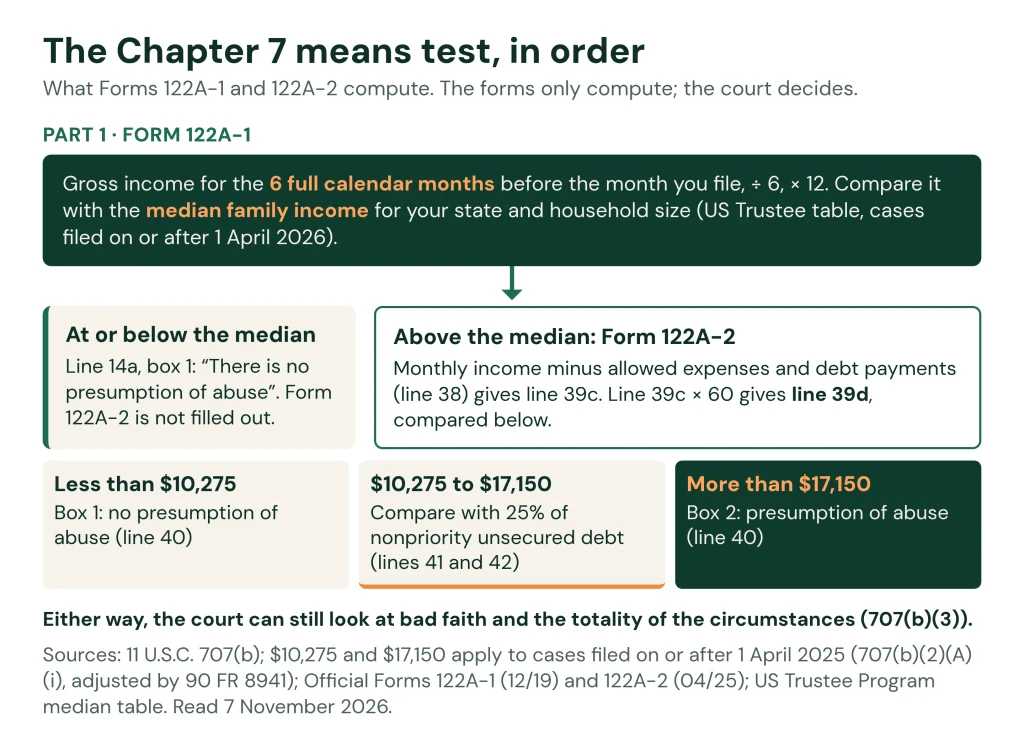
The Chapter 7 means test has two parts. First, your average monthly income from the 6 full months before you file, times 12, is compared with the median family income for your state and household size. Second, only if that figure is above the median, Form 122A-2 subtracts set living allowances and certain debt payments to see whether enough is left over to raise a “presumption of abuse”. This calculator, part of our means test and income limits guide, does both sums on the figures you enter, using the US Trustee’s median table for cases filed on or after 1 April 2026 and the IRS standards for cases filed on or after 15 July 2026. It gives estimates and shows its working. It cannot tell you whether you can file Chapter 7: the court decides that, and other rules can change the answer.
This page is general information, not legal, tax or financial advice, and not a substitute for the advice of an attorney. Bankruptcy law and exemption amounts vary by state and change. Ask a bankruptcy lawyer, legal aid or the court about your situation.
If you only want the median for your state, the Chapter 7 income limits table lists all 51. Every figure below was read on the US Trustee Program’s site, the official forms on uscourts.gov or the Bankruptcy Code itself on 7 November 2026, and carries the date it applies from.
The figures in force
The means test uses outside figures that change on three different timetables:
| Figure | Amount | Applies to cases filed | Source |
|---|---|---|---|
| State median family income, by household size | All 51 rows (Ohio, 3 people: $102,504) | On or after 1 April 2026 | US Trustee median table |
| Added for each person over 4 | $11,100 a year ($925 a month) | On or after 1 April 2025; next change 1 April 2028 | 11 U.S.C. 707(b)(7)(A)(iii), adjusted by 90 FR 8941 |
| National Standards: food, clothing and other items, per month | $867 (1 person), $1,558 (2), $1,857 (3), $2,176 (4), plus $397 for each extra person | On or after 15 July 2026 | IRS standards on the US Trustee site |
| Out-of-pocket health care, per person per month | $90 under 65; $163 at 65 or older | On or after 15 July 2026 | IRS standards on the US Trustee site |
| Vehicle ownership, per vehicle per month | $703 (at most two vehicles) | On or after 15 July 2026 | US Trustee transportation tables |
| Vehicle operating costs, one car per month | Regions: Northeast $330, Midwest $263, South $291, West $299; 23 metro areas have their own figure | On or after 15 July 2026 | US Trustee transportation tables |
| Public transportation, per month | $220 | On or after 15 July 2026 | US Trustee transportation tables |
| Presumption figures for line 39d | $10,275 and $17,150 | On or after 1 April 2025; next change 1 April 2028 | 11 U.S.C. 707(b)(2)(A)(i), adjusted by 90 FR 8941 |
Housing and utility allowances are set county by county, so the calculator asks you to enter your county’s two figures from the US Trustee’s housing charts. The same page has the Chapter 13 administrative expense multipliers by district, from 4.2% to 10.0% for cases filed on or after 15 July 2026. Districts in Alabama and North Carolina use the bankruptcy administrators’ figures, posted on uscourts.gov’s administrative expense multipliers page (for example 8.5% in the Middle District of North Carolina from 1 October 2026).
Check the US Trustee page before you file. The Trustee Program picks the table by the date a case is filed, from a drop-down on its means testing page. The median table has changed on 1 November in some years (it did for cases filed from 1 November 2025) as well as on 1 April, and the IRS figures change mid-year. On 7 November 2026 the newest entry was still “7/15/2026 or After”, with no newer median table posted.
How to use the calculator
- Pick your state, or tick the box for the District of Columbia, and enter the number of people in your household.
- Enter gross income for the 6 full calendar months before the month you would file: the total for you, and for your spouse if you file together or your spouse lives with you and you are not separated. The calculator divides by 6 and multiplies by 12.
- Read the first three results. They show the median in force, your annualised figure and the difference. A minus sign means your figure is below the median.
- If your figure is above the median, fill in the rest. These boxes follow Form 122A-2 line by line. The default numbers are the worked example further down, not typical amounts, so replace each one.
- Read the last results. They show lines 24, 37, 38, 39c and 39d of the form, the figure line 39d is compared with, and the difference between the two.
Nothing you type leaves your browser. The results are estimates from your own entries, and the official forms are what count.
Part 1: your income against the median
The first part is Official Form 122A-1, the Chapter 7 Statement of Your Current Monthly Income. Everyone filing Chapter 7 as an individual files it.
What counts as income
The Bankruptcy Code calls the figure “current monthly income”: the average monthly income from all sources, taxable or not, received in the 6 months ending on the last day of the month before the case is filed (11 U.S.C. 101(10A)). The form gives an example: if you file on 15 September, the period is 1 March to 31 August. A big bonus or a lost job inside those 6 months moves the average, which is why the filing date matters.
- Counted: wages, salary, tips, overtime and commissions before deductions; alimony; net business and rental income; interest and dividends; unemployment pay (the form lets you list it apart if you contend it is a Social Security Act benefit); pensions; and amounts someone else pays regularly toward your household’s expenses, such as child support or a partner’s or roommate’s regular contributions (Form 122A-1, lines 2 to 10).
- Left out by the Code: benefits under the Social Security Act; payments to victims of war crimes, crimes against humanity or terrorism; and pay, pensions and other payments under titles 10, 37 or 38 connected with a service member’s disability, combat-related injury or death, including VA disability compensation (101(10A)(B)(ii)). Military disability retired pay is left out only to the extent it is more than the retired pay you would get without the disability.

If you’re married
Form 122A-1 counts your spouse’s income in two cases: when you file together, and when your spouse is not filing but you live in the same household and are not legally separated. If you are legally separated, or living apart for reasons other than getting around the means test, you leave your spouse’s income out and declare that under penalty of perjury (707(b)(7)(B)). If your spouse doesn’t file, Form 122A-2 later lets you subtract the part of your spouse’s income not used for your household, such as payments on your spouse’s own tax debt. Our guide to bankruptcy and your spouse covers the rest.
Household size and the “same number or fewer” rule
The statute compares you with “the highest median family income of the applicable State for a family of the same number or fewer individuals”, and for a household over 4, the highest figure for 4 or fewer plus $925 a month for each extra person (707(b)(7)(A)). In the current table no state’s median drops for a bigger household, but some stay flat: Alaska is $112,548 for both 2 and 3 people, and the District of Columbia $161,397 for both. The calculator applies the statute’s wording either way.
Form 122A-1 just says “the number of people in your household”, and neither the form nor its instructions define household for the means test. If yours isn’t simple (shared custody, an adult child who comes and goes, a partner who pays some bills), ask a lawyer or legal aid how your court counts it, because one person more or fewer can move the median by thousands of dollars.
At or below the median
If your annualised figure is equal to or less than the median, Form 122A-1 line 14a says to check box 1, “There is no presumption of abuse”, and not to fill out Form 122A-2. The Code then bars anyone from bringing a motion based on the means test formula (707(b)(7)(A)). It doesn’t end the review altogether: the judge or the US Trustee (or the bankruptcy administrator, in Alabama and North Carolina) can still ask the court to dismiss a case under 707(b) as an abuse, though creditors and the case trustee can’t bring that motion (707(b)(6)), for example for bad faith or on “the totality of the circumstances” (707(b)(3), (b)(6)).
Part 2: the Form 122A-2 arithmetic
Above the median, you also file Official Form 122A-2, the Chapter 7 Means Test Calculation (current version dated 04/25). It starts from your current monthly income, takes off allowed expenses and debt payments, and multiplies what is left by 60, for five years. The calculator follows the form’s lines:
| Form lines | What they deduct | Set amount or your actual figure? |
|---|---|---|
| 6 and 7 | Food, clothing and other items; out-of-pocket health care | IRS National Standards, by number of people and age, whatever you spend |
| 8 to 10 | Housing and utilities, in two parts, less your home loan payments; line 10 is for a claim that the standard is wrong for you, with an explanation (the calculator has no box for line 10) | IRS Local Standards for your county |
| 11 to 15 | Vehicle operating and ownership costs, or public transportation | IRS Local Standards |
| 16 to 23 | Taxes, required payroll deductions, term life insurance, court-ordered support, required education, childcare, extra health care, certain phone services | What you actually pay |
| 25 to 31 | Health and disability insurance and health savings accounts, care of a family member, family-violence safety costs, extra home energy, school costs for children under 18, extra food and clothing, charitable giving | What you actually pay, some with limits and proof |
| 33 to 36 | Secured debt payments due in the next 60 months, divided by 60; past-due amounts to keep your home or car, divided by 60; past-due priority debts such as support and taxes, divided by 60; Chapter 13 administrative expense | Your actual contracts and debts |
Some of those lines have limits worth knowing. The school allowance on line 29 is at most $214.58 a month per child under 18 (the statute’s $2,575 a year, for cases filed on or after 1 April 2025), with documentation. Extra food and clothing on line 30 is capped at 5% of the National Standards figures for those items. The Code also says the court may not take a debtor’s charitable contributions into account when deciding whether to dismiss (707(b)(1)), and line 31 lets you deduct them.
Why a home or car loan doesn’t count twice
Lines 9 and 13 subtract your actual home and car loan payments from the IRS allowance (never below zero), and line 33 then deducts those same payments in full. In our arithmetic, the result is that you get the larger of the two: the standard or your actual payment. A $450 car payment and the $703 ownership standard give $703 in total; a $900 payment gives $900. The same goes for a mortgage against the county’s mortgage or rent figure. Each payment is the total due in the 60 months after filing, divided by 60, so a car loan with 2 years left counts as much less than its monthly payment. The form allows the ownership allowance only for a vehicle with a loan or lease payment, and for no more than two vehicles; a car you own outright still gets the operating allowance on line 12.
How line 39d is read
Line 39c is your monthly disposable income on the form’s terms; line 39d is that times 60. The form then compares it with fixed figures, for cases filed on or after 1 April 2025:
| Line 39d | What the form says to check |
|---|---|
| Less than $10,275 | Box 1, “There is no presumption of abuse” (line 40) |
| More than $17,150 | Box 2, “There is a presumption of abuse” (line 40) |
| $10,275 to $17,150 | Compare with 25% of your nonpriority unsecured debt (line 41). Less than that: box 1. Equal or more: box 2 (line 42) |
The calculator shows this as one comparison figure: 25% of the unsecured debt you enter, but never less than $10,275 or more than $17,150, which is how the statute words it (707(b)(2)(A)(i)). Its last result is line 39d minus that figure. Zero or more is where the statute’s comparison gives a presumption; a minus sign is below it. The form’s line 40 wording gives a different answer only if line 39d is exactly $17,150.
A worked example
This page is general information, not legal, tax or financial advice, and not a substitute for the advice of an attorney. Bankruptcy law and exemption amounts vary by state and change. Ask a bankruptcy lawyer, legal aid or the court about your situation.
These are the calculator’s default figures: an invented married couple in Franklin County, Ohio (Columbus), filing together, with one child. All the personal amounts are made up for the example.
| Step | Working | Result |
|---|---|---|
| Current monthly income | ($45,000 + $9,000) over 6 months ÷ 6 | $9,000 |
| Times 12 (122A-1, line 12b) | $9,000 × 12 | $108,000 |
| Median, Ohio, 3 people | UST table, cases filed from 1 April 2026 | $102,504 |
| Difference | $108,000 − $102,504 | $5,496 above, so Form 122A-2 is filled in |
| Line 24 | $1,857 food and other items + $270 health care (3 × $90) + $762 housing operating + $158 net mortgage ($1,558 − $1,400) + $526 two cars, Midwest region (2 × $263) + $253 net car ownership ($703 − $450) + $1,650 taxes + $700 lines 17 to 23 | $6,176 |
| Line 32 | Health insurance and other lines 25 to 31 | $700 |
| Line 37 | $1,400 mortgage + $450 car loan + $100 cure ($6,000 ÷ 60) + $82.80 Chapter 13 administrative expense ($900 projected payment × 9.2%, Southern District of Ohio) | $2,032.80 |
| Line 38, total deductions | $6,176 + $700 + $2,032.80 | $8,908.80 |
| Line 39c | $9,000 − $8,908.80 | $91.20 a month |
| Line 39d | $91.20 × 60 | $5,472 |
| Comparison figure | 25% of $40,000 unsecured debt is $10,000, raised to the $10,275 floor | $10,275 |
| Last result | $5,472 − $10,275 | −$4,803 |
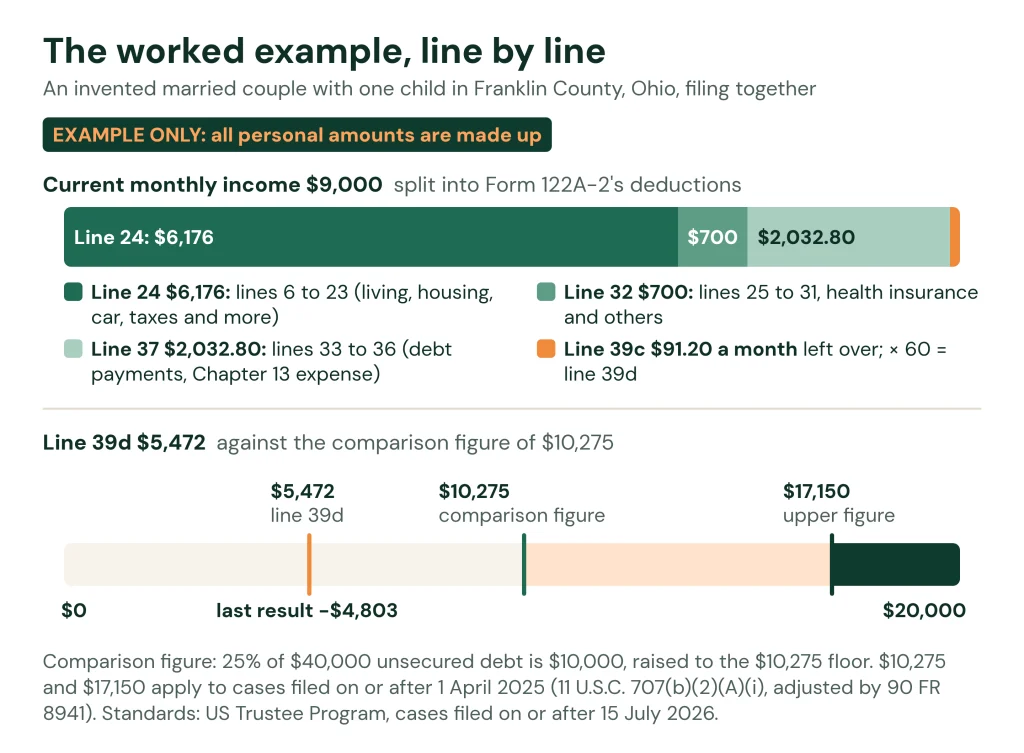
On these invented figures, the household is above the median, yet line 39d lands below $10,275, the first box on line 40. Being above the median is only the start of the form, not its result. Change one input and the picture can change: with $46,000 instead of $45,000 of income and $60,000 of unsecured debt, line 39d becomes $15,472.20. That falls between $10,275 and $17,150, so line 41 applies: 25% of $60,000 is $15,000, and line 39d is $472.20 above it.
What a presumption does and doesn’t mean
A “presumption of abuse” is the Code’s term, not an accusation. The official instructions put it plainly: it “does not mean you are actually trying to abuse the bankruptcy system”, only that you are presumed to have enough income that Chapter 7 relief shouldn’t be granted. What happens next is for the court:
- Who can act. After notice and a hearing, the court can dismiss the case, or with the debtor’s consent convert it to Chapter 11 or 13, on its own motion or on a motion by the US Trustee, the case trustee or another party in interest, such as a creditor (707(b)(1)).
- Special circumstances. The presumption can be rebutted only by special circumstances, such as a serious medical condition or a call to active military duty, that justify extra expenses or an income adjustment with no reasonable alternative. Each item must be itemised, documented, explained and sworn to, and it must bring line 39d below the comparison figure (707(b)(2)(B)). Part 4 of Form 122A-2 is where they go.
- No presumption isn’t the end either. Where the presumption doesn’t arise or is rebutted, the court still considers bad faith and the totality of the debtor’s financial situation (707(b)(3)).
The US Trustee Program notes that consumer debtors can instead reorganise under Chapter 13 with a repayment plan. How the two chapters differ is in our Chapter 7 vs Chapter 13 guide, and the Chapter 13 payment calculator does the arithmetic for a plan. Which chapter suits a household is a decision for the reader and a lawyer, not a calculator.
Line 36’s Chapter 13 expense only applies if you could be a Chapter 13 debtor. For cases filed now, 11 U.S.C. 109(e) limits Chapter 13 to an individual with regular income whose noncontingent, liquidated unsecured debts are under $526,700 and secured debts under $1,580,125 (amounts for cases filed on or after 1 April 2025, 90 FR 8941). A bill to replace them with one combined limit of $2,750,000, H.R. 7730, was sent to the President on 5 November 2026; as of 7 November 2026 it had not become law (bill status on govinfo).
Who the means test doesn’t apply to
Three groups can file Form 122A-1Supp with a signed Form 122A-1 instead of working through the test:
- Debts not primarily consumer debts. 707(b) applies to an individual “whose debts are primarily consumer debts”, meaning debts incurred “primarily for a personal, family, or household purpose” (101(8)). Someone whose debts are mostly from a business may fall outside it. How to classify debts is a question for a lawyer.
- Disabled veterans, as defined in 38 U.S.C. 3741(1), whose debts arose mainly while on active duty or performing a homeland defence activity (707(b)(2)(D)(i)). This exclusion is permanent.
- Reservists and National Guard members called to active duty or homeland defence after 11 September 2001 for at least 90 days, while serving and for 540 days afterwards (707(b)(2)(D)(ii)). This one applies only to cases begun within 19 years of the 2008 law taking effect, which by our arithmetic runs to about 18 December 2027.
In a joint case where an exclusion applies to only one spouse, the form instructions say separate forms may be required (707(b)(2)(C)).
Out-of-date figures you may see
Means test figures change often, and pages that use them go stale. Things to check on any calculator, including this one:
- $9,075 and $15,150 as the line 39d figures, or $825 a month per extra person: those applied to cases filed from 1 April 2022 to 31 March 2025. Since 1 April 2025 they are $10,275, $17,150 and $925 (Code notes to 707, 90 FR 8941).
- A median table with no date, or one for cases filed from 1 November 2025 or earlier. The table now in use applies to cases filed on or after 1 April 2026.
- “You qualify” or “you pass” as a result. The forms only compute; the court decides, and the exclusions, special circumstances and the totality test above all sit outside the arithmetic.
Your next step
- Gather: pay stubs and other income records for the 6 full calendar months before the month you might file, your most recent tax return, loan statements showing what is due over the next 60 months, and a list of debts split into secured, priority and unsecured.
- Read: Forms 122A-1, 122A-1Supp and 122A-2 on uscourts.gov and the US Trustee’s means testing data for the date you expect to file. Our page on whether you qualify for Chapter 7 covers the other conditions, such as the credit counselling course and the time since any earlier discharge.
- Ask: your bankruptcy court clerk or its self-help pages for local procedures (clerks can’t give legal advice), legal aid or a law school clinic for free help if you qualify, or a bankruptcy lawyer about your own figures.
- What can’t wait: if a foreclosure sale, a repossession or a wage garnishment is already scheduled, the date matters more than the means test, so take that date to a lawyer or legal aid first.
Sources checked on 7 November 2026: 11 U.S.C. 101, 109 and 707 on uscode.house.gov (current through Public Law 119-138, 3 November 2026) with the 1 April 2025 adjustments in 90 FR 8941, Official Forms 122A-1 (12/19), 122A-1Supp (12/15) and 122A-2 (04/25) and their instructions on uscourts.gov, the US Trustee Program’s means testing data for cases filed on or after 15 July 2026, the uscourts.gov administrative expense multipliers page, and the H.R. 7730 bill status on govinfo.
Formulas and sources
- State number (DC is 51): Arithmetic on the reader's entries
- Median, 1 earner, states 1 to 25: UST median table, cases filed from 1 Apr 2026
- Median, 1 earner, states 26 to 51: UST median table, cases filed from 1 Apr 2026
- Median, 2 people, states 1 to 25: UST median table, cases filed from 1 Apr 2026
- Median, 2 people, states 26 to 51: UST median table, cases filed from 1 Apr 2026
- Median, 3 people, states 1 to 25: UST median table, cases filed from 1 Apr 2026
- Median, 3 people, states 26 to 51: UST median table, cases filed from 1 Apr 2026
- Median, 4 people, states 1 to 25: UST median table, cases filed from 1 Apr 2026
- Median, 4 people, states 26 to 51: UST median table, cases filed from 1 Apr 2026
- Median in force for this state and household size, per year: 11 U.S.C. 707(b)(7)(A)
- Current monthly income (Form 122A-1, line 11): 11 U.S.C. 101(10A)
- Current monthly income x 12 (line 12b): Official Form 122A-1
- Line 12b minus the median: Official Form 122A-1
- Adjusted current monthly income (Form 122A-2, line 4): Official Form 122A-2 (04/25)
- Food, clothing and other items (line 6): IRS National Standards (UST), from 15 Jul 2026
- Out-of-pocket health care (line 7g): IRS health care standard (UST), from 15 Jul 2026
- Net mortgage or rent expense (line 9c): Official Form 122A-2 (04/25)
- Operating cost per vehicle for the area chosen: IRS transportation standards (UST), from 15 Jul 2026
- Vehicle operation expense (line 12): IRS transportation standards (UST), from 15 Jul 2026
- Net vehicle 1 ownership expense (line 13c): Official Form 122A-2 (04/25)
- Net vehicle 2 ownership expense (line 13f): Official Form 122A-2 (04/25)
- Public transportation (line 14 or 15): IRS transportation standards (UST), from 15 Jul 2026
- Expenses under the IRS standards and other necessary expenses (line 24): Official Form 122A-2 (04/25)
- Chapter 13 administrative expense (line 36): Official Form 122A-2 (04/25)
- Deductions for debt payment (line 37): Official Form 122A-2 (04/25)
- Total deductions (line 38): Official Form 122A-2 (04/25)
- Monthly disposable income (line 39c): Official Form 122A-2 (04/25)
- Monthly disposable income x 60 (line 39d): Official Form 122A-2 (04/25)
- Figure line 39d is compared with: 11 U.S.C. 707(b)(2)(A)(i), 90 FR 8941
- Line 39d minus that figure: 11 U.S.C. 707(b)(2)(A)(i), 90 FR 8941
- Added per person over 4, per year ($925 a month x 12) (11100, as of 2026-11-07): US Trustee median table footnote: add $11,100 for each individual in excess of 4
- National Standards, 1 person, per month (867, as of 2026-11-07): IRS National Standards (UST), from 15 Jul 2026
- National Standards, 2 people (1558, as of 2026-11-07): IRS National Standards (UST), from 15 Jul 2026
- National Standards, 3 people (1857, as of 2026-11-07): IRS National Standards (UST), from 15 Jul 2026
- National Standards, 4 people (2176, as of 2026-11-07): IRS National Standards (UST), from 15 Jul 2026
- National Standards, each person over 4 (397, as of 2026-11-07): IRS National Standards (UST), from 15 Jul 2026
- Out-of-pocket health care, under 65, per person (90, as of 2026-11-07): IRS health care standard (UST), from 15 Jul 2026
- Out-of-pocket health care, 65 and older, per person (163, as of 2026-11-07): IRS health care standard (UST), from 15 Jul 2026
- Vehicle ownership standard, per vehicle (703, as of 2026-11-07): IRS transportation standards (UST), from 15 Jul 2026
- Public transportation standard (220, as of 2026-11-07): IRS transportation standards (UST), from 15 Jul 2026
- Lower figure in 707(b)(2)(A)(i)(I) (10275, as of 2026-11-07): 11 U.S.C. 707(b)(2)(A)(i), 90 FR 8941
- Upper figure in 707(b)(2)(A)(i)(II) (17150, as of 2026-11-07): 11 U.S.C. 707(b)(2)(A)(i), 90 FR 8941
Sources
- 11 U.S.C. 707, dismissal and the means test (uscode.house.gov, current through Pub. L. 119-138)
- 11 U.S.C. 101(8), (10A), (39A), definitions
- 11 U.S.C. 109(e), who may be a Chapter 13 debtor (amounts adjusted by 90 FR 8941)
- US Trustee Program: Means Testing
- US Trustee Program: data for cases filed on or after 15 July 2026
- US Trustee Program: median family income table
- US Trustee Program: IRS National Standards
- US Trustee Program: out-of-pocket health care standard
- US Trustee Program: housing and utilities chart, Ohio
- US Trustee Program: Chapter 13 administrative expense multipliers
- uscourts.gov: Administrative Expense Multipliers (Alabama and North Carolina)
- Official Form 122A-1, Chapter 7 Statement of Your Current Monthly Income (12/19)
- Official Form 122A-1Supp (12/15)
- Official Form 122A-2, Chapter 7 Means Test Calculation (04/25)
- Instructions for Bankruptcy Forms for Individuals (April 2025)
- Federal Register, 90 FR 8941: adjustment of dollar amounts (4 Feb 2025)
- govinfo: H.R. 7730 bill status