A Chapter 13 plan payment is built from your own numbers. The plan must pay priority debts in full, secured claims it takes on with interest, missed payments it catches up, at least what unsecured creditors would get in a Chapter 7, and the trustee’s fee, which by law can’t exceed 10% of payments. If the trustee or an unsecured creditor objects, it must also pay unsecured claims in full or put all projected disposable income toward them for 3 or 5 years. In our example, a household of 3 with $550 a month left after expenses gets an estimate of $637.44 a month over 36 months, or $550.00 over 60. The trustee and the court decide what a plan must pay. This tool is part of our Chapter 13 guides.
This page is general information, not legal, tax or financial advice, and not a substitute for the advice of an attorney. Bankruptcy law and exemption amounts vary by state and change. Ask a bankruptcy lawyer, legal aid or the court about your situation.
The calculator does the sums that every Chapter 13 plan has to pass, using the figures you enter, and shows its working: the lowest payment that covers what the plan must pay, the income you have left after expenses, the trustee’s fee, how much would be left for card and medical debts, and the 3- or 5-year commitment period that applies to your income. It does not say whether you should file, which chapter fits, or what a court will confirm. For how a case runs from filing to discharge, see how Chapter 13 bankruptcy works.
How the estimate is built
There is no single payment formula in the Bankruptcy Code. Instead, a plan must pass several separate tests, and the payment has to be big enough for all of them at once. Each line below is a rule we read in the US Code on 7 November 2026 (text current through Public Law 119-138 of 3 November 2026).
| What the plan must do | The rule | How the calculator uses it |
|---|---|---|
| Pay priority claims in full | 11 U.S.C. 1322(a)(2), unless the holder of a claim agrees to less. Priority claims are listed in 507(a): past-due domestic support comes first, and some taxes qualify under 507(a)(8) | Adds your priority total in full |
| Pay each secured claim it covers the full allowed amount, with interest | 1325(a)(5)(B): the value of the payments “as of the effective date of the plan” must not be less than the allowed claim, and periodic payments must be in equal monthly amounts. The other options are the creditor’s acceptance of the plan or surrender of the property (1325(a)(5)(A), (C)) | Spreads the claim over the plan at the interest rate you enter, as an ordinary loan payment |
| Catch up missed payments | 1322(b)(5) lets a plan cure a default “within a reasonable time” while regular payments continue, on a debt whose last payment falls due after the plan ends, such as most mortgages; under 1322(e) the cure amount follows the loan agreement and state law | Adds the arrears you enter, with no interest unless you include it in the figure |
| Give unsecured creditors at least what a Chapter 7 would | 1325(a)(4), often called the best-interest or liquidation test | Makes sure the plan leaves at least the liquidation figure you enter for unsecured creditors. The statute compares values “as of the effective date of the plan”; the calculator adds no interest to that figure, so a real plan’s minimum can be higher |
| Pay all projected disposable income for the commitment period, if the trustee or an unsecured creditor objects | 1325(b)(1): either unsecured claims are paid in full, or all projected disposable income goes to unsecured creditors for the 3- or 5-year period in 1325(b)(4) | Takes the higher of the minimum and the income you have left after expenses |
| Pay the trustee | 28 U.S.C. 586(e): a percentage fee of no more than ten percent for a debtor who is not a family farmer, collected “from all payments received” under plans; 1326(b) pays it before or with each payment to creditors | Grosses the payment up so that, after the fee, the rest still covers the minimum |
| Be affordable | 1325(a)(6): the debtor “will be able to make all payments under the plan” | Shows the monthly gap if the minimum is more than the income left |
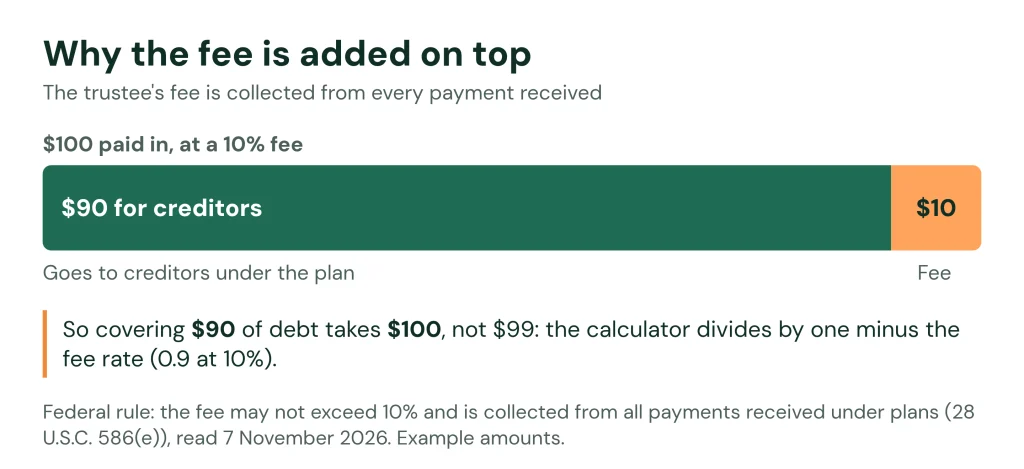
Put together, the calculator’s estimate is: the minimum the plan must pay, divided by the months, divided again by one minus the fee rate; or the income you have left after expenses, if that’s higher; but never more than it would take to pay every debt you entered in full. The trustee’s fee is worked out on the whole payment, because 586(e)(2) collects it from every payment received. At a 10% fee, $100 paid in leaves $90 for creditors, so covering $90 of debt takes $100, not $99.
A worked example
This page is general information, not legal, tax or financial advice, and not a substitute for the advice of an attorney. The household below is invented to show the arithmetic. Its figures are examples, not typical amounts, and the result is not what any court would confirm.
A household of 3 in Ohio has current monthly income of $5,000 before tax, or $60,000 a year. The Ohio median for 3 people in cases filed on or after 1 April 2026 is $102,504 (US Trustee median income table, read 7 November 2026), so the household is below the median and its commitment period is 3 years. Take-home income is $4,100 a month and living expenses are $3,550, leaving $550. It owes $3,000 in priority debt, is $6,000 behind on the mortgage, has a $9,000 car loan to be paid through the plan at an example rate of 8%, and owes $30,000 on cards and medical bills. Its own figures say a Chapter 7 trustee could raise $1,500 for unsecured creditors. The fee is set at the 10% maximum. These are the calculator’s default entries.
| Step | 36 months | 60 months |
|---|---|---|
| Car claim, $9,000 at 8%, a month | $282.03 | $182.49 |
| Car claim with interest, whole plan | $10,152.98 | $10,949.25 |
| Plus priority $3,000 and arrears $6,000 | $19,152.98 | $19,949.25 |
| Plus the $1,500 liquidation minimum | $20,652.98 | $21,449.25 |
| Divided by months, then by 0.9 for the fee | $637.44 | $397.21 |
| Income left after expenses | $550.00 | $550.00 |
| Estimated plan payment | $637.44 | $550.00 |
| Monthly gap over income left | $87.44 | $0.00 |
| Trustee’s fee, a month | $63.74 | $55.00 |
| Left for unsecured creditors, whole plan | $1,500.00 (5.0%) | $9,750.75 (32.5%) |
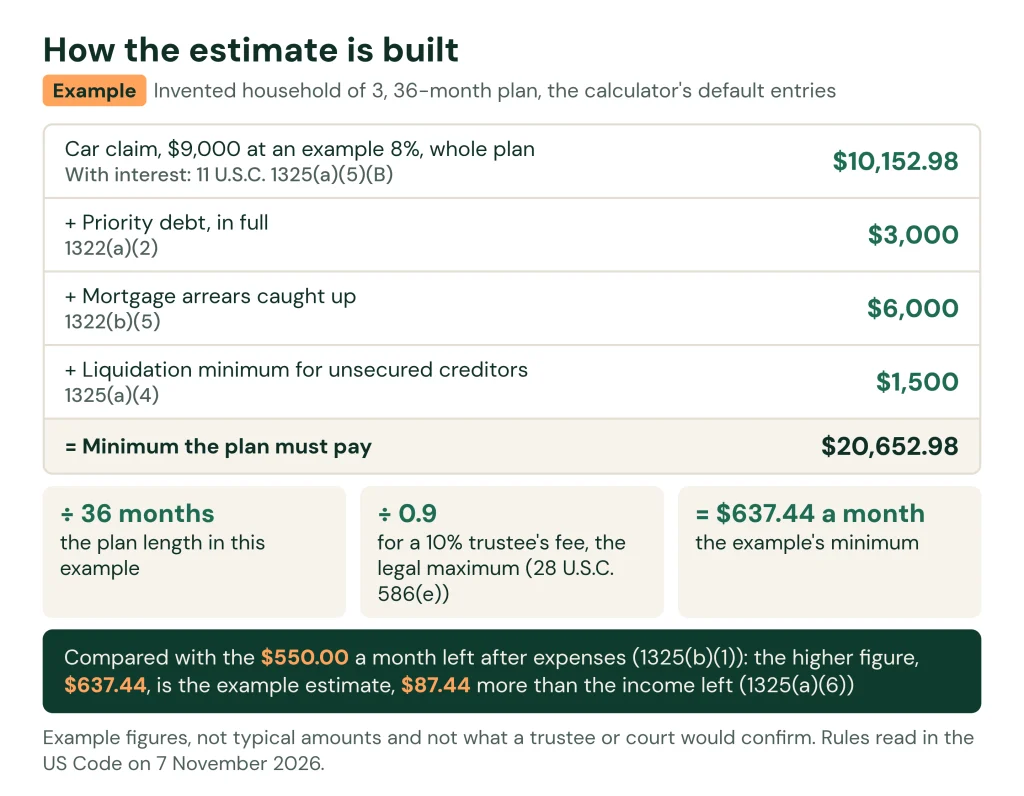
Over 36 months, the plan’s must-pays alone come to $637.44 a month, $87.44 more than the household has left. That gap is the arithmetic of the figures entered, not a ruling. Over 60 months the minimum drops to $397.21, below the $550 left, so the estimate becomes $550.00, and about a third of the card and medical debt would be paid. But this household is below the median, and 1322(d)(2) lets its plan run longer than 3 years only if the court, “for cause”, approves, and never longer than 5. Whether a longer plan must also pay all $550 for the extra two years is for the trustee and the court. The calculator assumes it does.
In the Southern District of Ohio, the US Trustee’s multiplier is 9.2% rather than 10%. Over 60 months that makes the minimum $393.71 and the fee $50.60 a month, and the estimate stays at $550.00, with $10,014.75 left for unsecured creditors. In this example, the fee rate moves the result less than the income and debt figures do.
3 years or 5: the commitment period
The “applicable commitment period” is how long a plan must pay all projected disposable income to unsecured creditors when the trustee or a creditor objects. Under 1325(b)(4) it is 3 years, or “not less than 5 years” if your current monthly income, with your spouse’s, times 12 is not less than your state’s median family income for your household size. For a household of 2 to 4, the statute uses the highest median for a family of that number or fewer. It can be shorter only if the plan pays all allowed unsecured claims in full in less time.
- Current monthly income is the average over the 6 full months before you file, from all sources, before tax. It includes money others pay regularly toward your household’s expenses. Social Security Act benefits, payments under titles 10, 37 and 38 connected with the disability, combat-related injury or death of a member of the uniformed services (disability retired pay only in part), and payments to victims of war crimes, crimes against humanity or terrorism are left out by the definition in 11 U.S.C. 101(10A). Form 122C-1 also has a marital adjustment for a spouse who isn’t filing. Income is reported on Form 122C-1 (version 10/19).
- The median comes from the US Trustee’s table: medians for cases filed on or after 1 April 2026, with $925 a month ($11,100 a year) added for each person over 4 (1325(b)(4), amount for cases filed on or after 1 April 2025; next adjustment 1 April 2028). Our income limits by state and household size list every state’s figure.
- Exactly at the median counts as above. The statute says “not less than”, and line 21 of Form 122C-1 gives 5 years when income is “more than or equal to” the median. The calculator does the same.
- Plan length is a separate limit. At or above the median, a plan may not run longer than 5 years (1322(d)(1)). Below it, 3 years unless the court approves more for cause, and never more than 5 (1322(d)(2)). A plan changed after confirmation may not run past the commitment period unless the court approves more for cause, and never past 5 years, counted from when the first payment under the original confirmed plan was due (1329(c)).
- Your income can change the expenses side too. If your income times 12 is greater than the median, 1325(b)(3) measures disposable income with the means-test expense standards on Form 122C-2 (version 04/25), not your actual budget. Line 45 of that form gives the monthly figure. To test it here, enter it as income and 0 as expenses. That form already deducts some plan costs, such as secured debt payments and the trustee’s expense, so treat the result as a rough check only.
Disposable income is a forward-looking figure. In Hamilton v. Lanning, 560 U.S. 505 (2010), the Supreme Court held that a court calculating projected disposable income may account for changes in income or expenses that are “known or virtually certain at the time of confirmation”. A raise, a job loss or a car loan ending during the plan can matter, and the calculator can’t see any of them.
The trustee’s fee, district by district
Each Chapter 13 case has a trustee who collects your payments and pays creditors under the plan. The Attorney General fixes each standing trustee’s percentage fee, which may not exceed 10% (28 U.S.C. 586(e)(1)(B); a different cap applies to family farmers). The official plan form, Form 113, says the fees “are governed by statute and may change during the course of the case” and asks for an estimated percentage. A court may adopt its own local plan form instead, under Rules 3015(c) and 3015.1. Alabama and North Carolina have Bankruptcy Administrators instead of the US Trustee Program, and we did not confirm which rule sets the trustee’s fee there; the court or its Bankruptcy Administrator can say.
The district figures we found are the administrative expense multipliers used on line 36 of Form 122C-2: the US Trustee’s list for cases filed on or after 15 July 2026, and the Bankruptcy Administrators’ list for Alabama and North Carolina, effective 1 October 2026. The US Trustee calls its list a schedule of the actual administrative expenses of a Chapter 13 plan in each district, issued under 11 U.S.C. 707(b)(2)(A)(ii)(III). It is a figure for the forms, not a promise of what your trustee will charge, but it is a reasonable place to start. The table copies both lists as we read them on 7 November 2026.
| State or territory | Multiplier by judicial district |
|---|---|
| Alabama | Northern 7.38%; Middle 5.64%; Southern 5.32% (Bankruptcy Administrator list, effective 1 Oct 2026) |
| Alaska | 10.0% |
| Arizona | 10.0% |
| Arkansas | Eastern 9.3%; Western 9.3% |
| California | Central 10.0%; Eastern 7.0%; Northern 10.0%; Southern 10.0% |
| Colorado | 10.0% |
| Connecticut | 10.0% |
| Delaware | 9.7% |
| District of Columbia | 9.1% |
| Florida | Middle 10.0%; Northern 10.0%; Southern 6.1% |
| Georgia | Middle 6.8%; Northern 7.7%; Southern 9.7% |
| Guam | 9.1% |
| Hawaii | 9.1% |
| Idaho | 9.8% |
| Illinois | Central 10.0%; Northern 6.9%; Southern 8.5% |
| Indiana | Northern 5.3%; Southern 7.7% |
| Iowa | Northern 7.9%; Southern 7.9% |
| Kansas | 8.8% |
| Kentucky | Eastern 7.6%; Western 4.2% |
| Louisiana | Eastern 9.2%; Middle 9.3%; Western 10.0% |
| Maine | 9.9% |
| Maryland | 9.1% |
| Massachusetts | 10.0% |
| Michigan | Eastern 10.0%; Western 9.6% |
| Minnesota | 7.9% |
| Mississippi | Northern 7.1%; Southern 10.0% |
| Missouri | Eastern 6.6%; Western 7.3% |
| Montana | 10.0% |
| Nebraska | 8.4% |
| Nevada | 9.5% |
| New Hampshire | 10.0% |
| New Jersey | 8.7% |
| New Mexico | 9.5% |
| New York | Eastern 9.0%; Northern 10.0%; Southern 9.3%; Western 9.9% |
| North Carolina | Eastern 6%; Middle 8.5%; Western 5.5% (Bankruptcy Administrator list, effective 1 Oct 2026) |
| North Dakota | 7.9% |
| Northern Mariana Islands | 9.1% |
| Ohio | Northern 10.0%; Southern 9.2% |
| Oklahoma | Eastern 10.0%; Northern 9.4%; Western 6.9% |
| Oregon | 10.0% |
| Pennsylvania | Eastern 9.2%; Middle 7.0%; Western 6.0% |
| Puerto Rico | 10.0% |
| Rhode Island | 10.0% |
| South Carolina | 9.8% |
| South Dakota | 7.9% |
| Tennessee | Eastern 5.9%; Middle 4.8%; Western 10.0% |
| Texas | Eastern 9.5%; Northern 10.0%; Southern 9.8%; Western 9.8% |
| Utah | 9.6% |
| Vermont | 10.0% |
| Virgin Islands | 10.0% |
| Virginia | Eastern 10.0%; Western 10.0% |
| Washington | Eastern 9.1%; Western 7.6% |
| West Virginia | Northern 8.6%; Southern 8.6% |
| Wisconsin | Eastern 7.8%; Western 7.0% |
| Wyoming | 8.4% |
The calculator shows two fee lines: the estimate at the rate you enter, and the payment at the 10% maximum, so you can see the most the fee can move the result.
What the calculator leaves out
A real plan goes through rules no simple tool can test. These are the ones most likely to move a payment:
- The interest rate on secured claims. The Code requires present value but sets no rate. In Till v. SCS Credit Corp., 541 U.S. 465 (2004), a plurality of the Supreme Court approved a “formula” approach: the national prime rate, adjusted up for the risk of nonpayment after a hearing. It noted that other courts had generally approved adjustments of 1% to 3%. Your plan’s rate is set in your case, so try a few rates in the calculator.
- Recent car loans. A plan can sometimes pay a secured claim only up to the value of the collateral. Under the paragraph after 1325(a)(9), that option is not available for a purchase-money loan taken out within 910 days before filing for a vehicle bought for your personal use, or within 1 year for other collateral. Ask about the date of your loan before entering the vehicle’s value instead of the balance. Our page on what happens to your car in bankruptcy explains the choices.
- Your home loan. A plan may not change the terms of a claim secured only by your principal residence (1322(b)(2)), but it may cure a default and keep up regular payments (1322(b)(5)), and under 1322(c)(1) the right to cure lasts until the home is sold at a foreclosure sale held under state law. More in can bankruptcy stop a foreclosure.
- Support owed to a government. Under 1322(a)(4), a plan may pay less than the full amount of a domestic support claim assigned to or owed to a government (507(a)(1)(B)) only if all projected disposable income for 5 years goes into the plan.
- Payments before confirmation. Unless the court orders otherwise, payments start no later than 30 days after you file the plan or the case, whichever is earlier (1326(a)(1)). The trustee holds them until the plan is confirmed or denied.
- Other conditions of confirmation. Support that falls due after filing must be paid (1325(a)(8)), and any tax returns you were required to file for the 4 years before filing must be filed with the tax authorities by the day before the first date set for the meeting of creditors, though the trustee may hold the meeting open for a limited extra time (1308(a); 1325(a)(9)).
- Who can file Chapter 13 at all. Chapter 13 is for an individual (or a married couple) with regular income. In cases filed on 7 November 2026, debts must be under $526,700 unsecured and under $1,580,125 secured, counting noncontingent, liquidated debts on the filing date (109(e), amounts in force for cases filed on or after 1 April 2025; next adjustment 1 April 2028). A bill to replace these two limits with one combined limit of $2,750,000, H.R. 7730, was sent to the President on 5 November 2026. As of 7 November 2026 it had not become law (bill status at govinfo).
- Court costs and lawyer’s fees. The Chapter 13 filing fee is $313: a $235 statutory fee (28 U.S.C. 1930(a)(1)(B)) plus a $78 administrative fee (miscellaneous fee schedule, effective 1 December 2023). It is paid to the court and is not in the calculator. Lawyers’ fees vary and some are paid through the plan; we publish no typical figure. See what it costs to file bankruptcy.
Plans can change after confirmation too. Under 1329(a) the debtor, the trustee or an unsecured creditor can ask to raise or lower payments, or to extend or shorten the time, before the plan is finished, within the same 5-year limit. Our guide to Chapter 13 payment plans covers length, limits and changes.
Claims you may see elsewhere
- “Your payment is just what you can afford.” Only partly. Income left after expenses is one test; the minimums in 1322(a) and 1325(a) apply whatever the budget shows, and 1325(a)(6) asks whether you can make the payments.
- “Chapter 13 plans can run 7 years.” Not under the Code in force. 1322(d) and 1329(c) cap plans at 5 years. A temporary pandemic-era modification rule, former 1329(d), has since been removed.
- “The Chapter 13 debt limit is $2.75 million.” Out of date: that temporary combined limit ended on 21 June 2024. The separate limits above apply unless H.R. 7730 becomes law, and then only cases filed on or after its enactment would use the new limit.
- “The trustee takes 10%.” 10% is the legal ceiling, not a set rate. The district multipliers in the table, which are figures for the forms rather than any trustee’s actual fee, run from 4.2% to 10.0%.
Your next step
Run the calculator with your own figures, then with a longer plan, a different interest rate and your district’s multiplier, and note which entry moves the result most. That is usually the figure worth checking first.

- Gather: pay stubs and other income records for the 6 full calendar months before you would file, your last 4 years of tax returns, the latest statements for every debt, your mortgage or car lender’s arrears figure, and a month of real household spending.
- Read: Schedules I and J, Forms 122C-1 and 122C-2, and the Form 113 plan on uscourts.gov, with their instructions. Check your bankruptcy court’s website for a local plan form, and the Chapter 13 trustee’s own site for payment rules.
- Ask: the bankruptcy court clerk (about forms and fees, not advice), the court’s self-help pages, a legal aid office or law school clinic, or a bankruptcy lawyer. Most filers must first take credit counselling in the 180 days before filing (109(h) has narrow exceptions), from an agency on the US Trustee’s approved list (in Alabama and North Carolina, ask the Bankruptcy Administrator). The US Trustee says it has not reviewed or approved the agencies’ other services.
- What can’t wait: a foreclosure sale date, a wage garnishment or a repossession notice. Write the date down and take it to whoever you ask first.
Every result on this page is an estimate from the figures you enter. It is not what a trustee will recommend or a court will confirm.
Sources checked on 7 November 2026.
Formulas and sources
- Current monthly income times 12: 11 U.S.C. 1325(b)(4): applicable commitment period, 3 years or not less than 5
- Applicable commitment period in months: 11 U.S.C. 1325(b)(4): applicable commitment period, 3 years or not less than 5
- Months below the commitment period: 11 U.S.C. 1325(b)(4): applicable commitment period, 3 years or not less than 5
- Monthly income left after expenses: Official Form 106J, Schedule J, line 23c: monthly net income, Schedule I line 12 less expenses
- Trustee's fee as a share: 28 U.S.C. 586(e): standing trustee's percentage fee, not to exceed 10 percent, collected from all plan payments
- Monthly interest rate: 11 U.S.C. 1325(a)(5)(B): secured claim paid its allowed amount in present value, equal monthly payments
- Monthly payment on secured claims in the plan: 11 U.S.C. 1325(a)(5)(B): secured claim paid its allowed amount in present value, equal monthly payments
- Secured claims with interest over the plan: 11 U.S.C. 1325(a)(5)(B): secured claim paid its allowed amount in present value, equal monthly payments
- Must-pays over the plan, before unsecured creditors: 11 U.S.C. 1322(a)(2): priority claims paid in full unless the holder agrees otherwise
- Minimum for unsecured creditors, liquidation test: 11 U.S.C. 1325(a)(4): unsecured creditors get at least what a Chapter 7 liquidation would pay
- Plan minimum before the trustee's fee: 11 U.S.C. 1325(a)(4): unsecured creditors get at least what a Chapter 7 liquidation would pay
- Payment that covers the minimum and the fee: 28 U.S.C. 586(e): standing trustee's percentage fee, not to exceed 10 percent, collected from all plan payments
- Payment that would pay every debt entered in full: 28 U.S.C. 586(e): standing trustee's percentage fee, not to exceed 10 percent, collected from all plan payments
- Estimated monthly plan payment: 11 U.S.C. 1325(b)(1)(B), (b)(2): projected disposable income to unsecured creditors if the trustee or a creditor objects
- Estimated trustee's fee a month: 11 U.S.C. 1326(b): trustee's fee and unpaid administrative claims paid before or with each payment to creditors
- Estimated trustee's fee over the plan: 28 U.S.C. 586(e): standing trustee's percentage fee, not to exceed 10 percent, collected from all plan payments
- Estimated total paid into the plan: Arithmetic on the reader's own entries, no outside figure
- Estimated left for unsecured creditors: Arithmetic on the reader's own entries, no outside figure
- Estimated share of unsecured debts repaid: Arithmetic on the reader's own entries, no outside figure
- Monthly gap: minimum payment over income left: Arithmetic on the reader's own entries, no outside figure
- Estimated payment at the 10% fee maximum: 28 U.S.C. 586(e): standing trustee's percentage fee, not to exceed 10 percent, collected from all plan payments
- Most a standing trustee's percentage fee may be (10, as of 2026-11-07): 28 U.S.C. 586(e): standing trustee's percentage fee, not to exceed 10 percent, collected from all plan payments
Sources
- 11 U.S.C. 1322, Contents of plan
- 11 U.S.C. 1325, Confirmation of plan
- 11 U.S.C. 1326, Payments
- 11 U.S.C. 1329, Modification of plan after confirmation
- 11 U.S.C. 1308, Filing of prepetition tax returns
- 11 U.S.C. 507, Priorities
- 11 U.S.C. 109, Who may be a debtor
- 11 U.S.C. 101(10A), Current monthly income
- 28 U.S.C. 586(e), Standing trustee's percentage fee
- US Trustee Program, Chapter 13 administrative expenses multiplier, cases filed on or after 15 July 2026
- uscourts.gov, Administrative Expense Multipliers (Alabama and North Carolina)
- US Trustee Program, median family income table, cases filed on or after 1 April 2026
- Official Form 122C-1, Chapter 13 Statement of Your Current Monthly Income and Calculation of Commitment Period
- Official Form 122C-2, Chapter 13 Calculation of Your Disposable Income
- Official Form 106I, Schedule I: Your Income
- Official Form 106J, Schedule J: Your Expenses
- Official Form 113, Chapter 13 Plan
- Federal Rules of Bankruptcy Procedure, compilation dated 1 December 2025
- Till v. SCS Credit Corp., 541 U.S. 465 (2004)
- 28 U.S.C. 1930, Bankruptcy fees
- Bankruptcy Court Miscellaneous Fee Schedule, effective 1 December 2023
- Hamilton v. Lanning, 560 U.S. 505 (2010)
- H.R. 7730 bill status, govinfo
- US Trustee Program, approved credit counseling agencies