Chapter 7 has no fixed income cap. The “income limit” people talk about is the first step of the means test: your state’s median family income for your household size, from a table the US Trustee Program publishes. For cases filed on or after 1 April 2026, for households of one to four people it runs, across the states and DC, from $53,978 a year for one person in Mississippi to $178,524 for a family of four in Massachusetts. In Texas it is $66,837 for one person and $117,962 for four. If your household’s average monthly income for the six full calendar months before the month you file, times 12, is at or below the figure for your state and household size, the means test forms stop there. If it is above, you fill in a second form. That second form decides whether a “presumption of abuse” arises; being over the median doesn’t on its own rule out Chapter 7.
This page is general information, not legal, tax or financial advice, and not a substitute for the advice of an attorney. Bankruptcy law and exemption amounts vary by state and change. Ask a bankruptcy lawyer, legal aid or the court about your situation.
Below are the lookup, the full table for all 50 states, DC and the four territories, the rules that change which figure applies to you, what counts as income, and what the same figure decides in Chapter 13. Every figure was checked against the US Trustee’s table on 7 November 2026.
How the lookup works
Choose your state, or DC or a territory in the second box, and enter the number of people in your household. The lookup shows:
- The median in force for that state and household size, per year and per month. For a household of 2, 3 or 4 it uses the highest figure for that number of people or fewer, as the statute says. For 5 or more it adds $11,100 a year for each extra person.
- An optional comparison. If you add up your gross income from all sources for the last six full calendar months and enter the total, it doubles it (the six-month average times 12 is the same as the six-month total times 2) and shows the difference from the median. A minus sign means the figure you entered is below the median.
The result is an estimate built from the numbers you type. It can’t tell whose income belongs in the total, who counts as part of your household, or whether the means test applies to your case at all. Those questions are covered below, and some of them are for the court.
Median income by state and household size
These are the figures the official forms ask for, as the US Trustee publishes them, for cases filed on or after 1 April 2026. The Trustee republished the same median table for cases filed on or after 15 July 2026, when the IRS expense figures changed and the medians did not. To turn a yearly figure into the monthly figure, divide by 12.
| State | 1 earner | 2 people | 3 people | 4 people |
|---|---|---|---|---|
| Alabama | $64,321 | $77,451 | $92,698 | $106,740 |
| Alaska | $85,817 | $112,548 | $112,548 | $142,136 |
| Arizona | $73,935 | $89,027 | $104,965 | $121,174 |
| Arkansas | $58,421 | $73,630 | $82,329 | $97,054 |
| California | $79,253 | $102,797 | $116,541 | $139,071 |
| Colorado | $87,940 | $109,497 | $130,850 | $153,501 |
| Connecticut | $84,302 | $106,224 | $134,470 | $159,934 |
| Delaware | $69,515 | $94,877 | $111,273 | $132,244 |
| District of Columbia | $85,391 | $161,397 | $161,397 | $166,598 |
| Florida | $69,876 | $86,523 | $97,540 | $114,761 |
| Georgia | $68,478 | $84,965 | $101,479 | $123,481 |
| Hawaii | $85,254 | $106,202 | $123,454 | $142,181 |
| Idaho | $73,413 | $86,160 | $98,381 | $119,662 |
| Illinois | $73,180 | $93,934 | $113,625 | $137,902 |
| Indiana | $64,461 | $81,986 | $95,627 | $115,656 |
| Iowa | $67,617 | $88,800 | $104,133 | $126,058 |
| Kansas | $69,197 | $87,441 | $103,852 | $125,971 |
| Kentucky | $61,652 | $73,892 | $85,212 | $109,443 |
| Louisiana | $59,447 | $72,348 | $84,602 | $103,628 |
| Maine | $75,892 | $90,445 | $106,822 | $131,577 |
| Maryland | $86,928 | $114,611 | $135,949 | $166,173 |
| Massachusetts | $88,202 | $112,708 | $139,411 | $178,524 |
| Michigan | $67,352 | $83,432 | $103,449 | $123,010 |
| Minnesota | $77,696 | $98,328 | $126,487 | $149,882 |
| Mississippi | $53,978 | $70,328 | $82,846 | $97,464 |
| Missouri | $64,972 | $82,075 | $100,228 | $118,530 |
| Montana | $71,310 | $91,452 | $103,285 | $121,698 |
| Nebraska | $66,922 | $90,728 | $103,405 | $125,074 |
| Nevada | $72,222 | $87,914 | $101,638 | $114,110 |
| New Hampshire | $87,287 | $109,324 | $141,531 | $155,203 |
| New Jersey | $87,173 | $106,876 | $137,136 | $168,127 |
| New Mexico | $66,235 | $79,574 | $88,041 | $98,602 |
| New York | $73,272 | $92,902 | $115,579 | $139,040 |
| North Carolina | $67,117 | $84,384 | $101,535 | $116,737 |
| North Dakota | $73,549 | $96,352 | $106,686 | $137,817 |
| Ohio | $66,239 | $83,725 | $102,504 | $123,702 |
| Oklahoma | $61,180 | $77,208 | $86,845 | $101,798 |
| Oregon | $79,089 | $93,670 | $116,729 | $140,024 |
| Pennsylvania | $72,230 | $87,534 | $110,151 | $135,862 |
| Rhode Island | $77,653 | $98,736 | $119,419 | $137,479 |
| South Carolina | $64,808 | $83,761 | $95,672 | $116,314 |
| South Dakota | $69,190 | $89,809 | $100,883 | $130,738 |
| Tennessee | $63,979 | $82,846 | $97,511 | $109,585 |
| Texas | $66,837 | $86,714 | $99,273 | $117,962 |
| Utah | $87,898 | $95,757 | $112,751 | $131,741 |
| Vermont | $72,461 | $96,963 | $114,075 | $137,583 |
| Virginia | $78,491 | $101,171 | $123,159 | $144,826 |
| Washington | $88,585 | $107,100 | $131,737 | $156,567 |
| West Virginia | $63,908 | $68,592 | $92,050 | $93,672 |
| Wisconsin | $71,168 | $90,252 | $108,516 | $133,384 |
| Wyoming | $71,745 | $91,502 | $98,476 | $110,297 |
The Trustee’s table also lists the four territories:
| Territory | 1 earner | 2 people | 3 people | 4 people |
|---|---|---|---|---|
| Guam | $53,859 | $64,399 | $73,385 | $88,805 |
| Northern Mariana Islands | $36,168 | $36,168 | $42,080 | $61,891 |
| Puerto Rico | $30,665 | $30,665 | $40,976 | $50,543 |
| Virgin Islands | $42,734 | $51,360 | $54,760 | $59,995 |
The Trustee’s data page for cases filed on or after 15 July 2026 says the figures come from the Census Bureau and are “updated each year”, and that under 11 U.S.C. 101(39A)(B) they are “further adjusted early each calendar year” for inflation (the Consumer Price Index for All Urban Consumers). The table in force now uses Census data published in September 2025. Since the start of 2025 the medians have changed on 1 April 2025, 1 November 2025 and 1 April 2026. Other dates on the Trustee’s list, such as 15 May 2025 and 15 July 2026, updated the IRS expense figures and left the medians unchanged. As of 7 November 2026 the US Trustee’s means testing page lists nothing newer than the table for cases filed on or after 15 July 2026. The table that applies is the one for the date your case is filed, so check that page again before filing.
Rules that change the figure
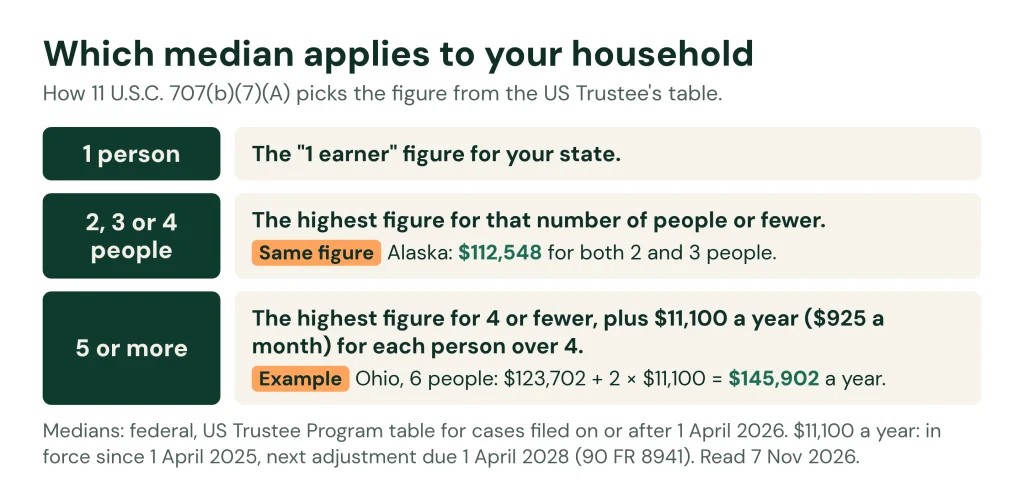
“The same number or fewer”
The statute doesn’t simply say “the median for your household size”. For a household of 2, 3 or 4, it says “the highest median family income of the applicable State for a family of the same number or fewer individuals” (11 U.S.C. 707(b)(7)(A)(ii)). For one person it is the figure for “1 earner”. In the current table no state has a smaller figure for a bigger household, but some have the same one: Alaska’s figure is $112,548 for both 2 and 3 people, DC’s is $161,397 for both, and Puerto Rico and the Northern Mariana Islands have the same figure for 1 and 2. The lookup applies the rule anyway, so a later table where a column dips would still give the statute’s figure.
Households of 5 or more
For more than 4 people, the statute takes the highest figure for 4 or fewer and adds a fixed amount a month for each person over 4 (707(b)(7)(A)(iii)). The Code prints $525. It is adjusted every three years, and since 1 April 2025 it has been $925 a month, or $11,100 a year (90 FR 8941; the Trustee’s table carries the same $11,100 footnote). The next adjustment is due 1 April 2028. So a household of 6 in Ohio has $123,702 + 2 × $11,100 = $145,902. The extra amount is the same in every state.
Who counts as your household
Official Form 122A-1 asks you to “fill in the number of people in your household”. Neither 707 nor the definitions in section 101 define “household” for this test, so who counts (a partner, an adult child, a relative who stays part of the year) can be a question for your lawyer or the court. The official instructions for individuals, in their note on the fee waiver form, say a household “may include your unmarried partner and others who live with you and with whom you share income and expenses”; that note is about other forms, not this test. The household figure and the income figure are linked: money that others in the household pay regularly toward your household expenses counts as income (below).

What counts as income for the comparison
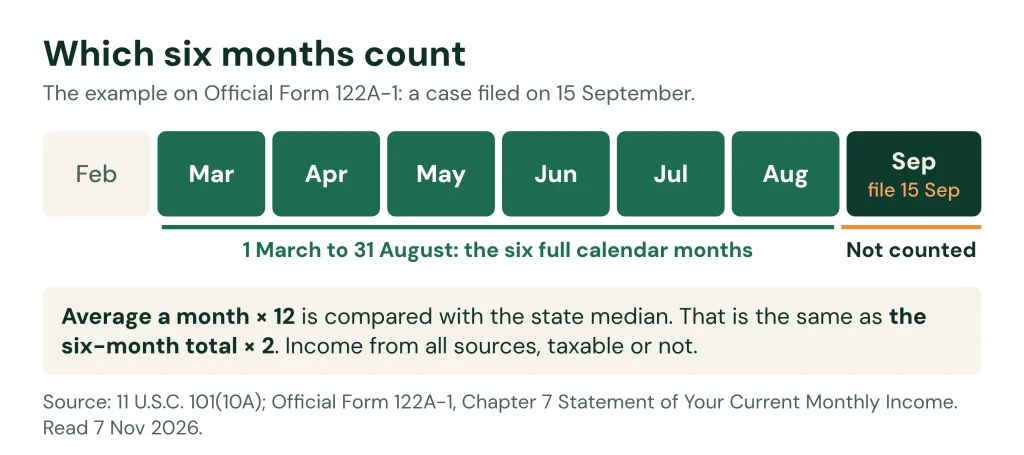
The figure compared with the median is “current monthly income” times 12. Current monthly income has a precise meaning in 11 U.S.C. 101(10A):
- It is an average over six full calendar months, ending on the last day of the month before you file. The form’s own example: if you file on 15 September, the period is 1 March through 31 August. It is a look back at what came in, not what you expect to earn from now on.
- It counts income “from all sources”, taxable or not. Form 122A-1 has lines for gross wages, overtime, bonuses and commissions; alimony; net income from a business or from rental property; interest and dividends; unemployment compensation; pensions; and anything else.
- It includes money someone else pays regularly toward your household expenses, such as child support or regular contributions from a partner, parent or roommate (101(10A)(B)(i)).
- It leaves out benefits under the Social Security Act; payments to victims of war crimes, crimes against humanity or terrorism; and pay, pensions and compensation under titles 10, 37 and 38 connected with the disability, combat-related injury or death of a member of the uniformed services, with a limit for some disability retired pay (101(10A)(B)(ii)). The US Trustee publishes questions and answers on the veterans’ exclusion.
If you are married. In a joint case both spouses’ income counts. If your spouse isn’t filing with you but lives with you, the comparison still uses your income and your spouse’s combined (707(b)(7)(A)). Your spouse’s income is left out only if you are legally separated, or living apart for reasons other than getting around the means test, and you file a statement under penalty of perjury saying so and disclosing any money your spouse gives you (707(b)(7)(B)). Form 122A-1 asks this in its first question. Our page on bankruptcy and your spouse goes through the rest.
What being below or above the median means
Line 14 of Form 122A-1 does the comparison. If the yearly figure is “less than or equal to” the median, you tick “There is no presumption of abuse” and do not fill out Form 122A-2. If it is more, you go on to Form 122A-2, the Chapter 7 Means Test Calculation. Here is what the statute attaches to each side.
At or below the median
- No judge, US Trustee, trustee or other party, such as a creditor, may bring a motion based on the presumption of abuse (707(b)(7)(A)).
- Only the judge or the US Trustee (or a bankruptcy administrator, where there is one) may ask to dismiss the case for abuse at all; creditors and the case trustee can’t (707(b)(6)). This rule looks at the debtor’s own income, or both spouses’ in a joint case, rather than the combined figure with a non-filing spouse.
- That isn’t a guarantee. On such a motion the court can still look at whether the case was filed in bad faith or whether “the totality of the circumstances” shows abuse (707(b)(3)). Other parts of the Code, such as the rules on prior discharges and on property, still apply.
Above the median
Form 122A-2 takes current monthly income and subtracts allowed expenses: IRS National and Local Standards, certain actual expenses, average payments on secured debts over 60 months, and priority debts (including priority child support and alimony), divided by 60 (707(b)(2)(A)). It multiplies what is left by 60. A presumption of abuse arises if that figure is at least the lesser of $17,150 or 25% of your nonpriority unsecured debts, with $10,275 as the floor for the 25% figure (amounts in force for cases filed on or after 1 April 2025, next adjusted 1 April 2028). A presumption can be rebutted only by documented “special circumstances”, such as a serious medical condition or a call to active duty (707(b)(2)(B)). Our means test calculator runs that arithmetic on figures you enter, and our page on who can file Chapter 7 covers the other requirements.
When the means test doesn’t apply
- Debts that aren’t mainly consumer debts. 707(b) covers individuals “whose debts are primarily consumer debts”, meaning debts incurred “primarily for a personal, family, or household purpose” (101(8)). Someone whose debts are mainly from a business files Form 122A-1Supp; the official instructions say they then need only sign Form 122A-1, not fill in the comparison.
- Disabled veterans (as defined in 38 U.S.C. 3741(1)) whose debts arose mainly while on active duty or performing a homeland defense activity (707(b)(2)(D)(i)).
- Reservists and National Guard members called to active duty or homeland defense activity after 11 September 2001 for at least 90 days, while serving and for 540 days after (707(b)(2)(D)(ii)). This exclusion is temporary: as last extended in December 2023 (Pub. L. 118-24), it applies only to cases filed in the 19 years from 19 December 2008, that is, before 19 December 2027 (statutory note to 11 U.S.C. 707, read 7 November 2026). Form 122A-1 has a box for “qualified military service”.
The same figure in Chapter 13
Chapter 13 doesn’t use the median to decide who may file; it has debt limits instead. But the same median table, applied the same way, sets two things in a Chapter 13 plan:
- The commitment period. If current monthly income of the debtor and spouse combined, times 12, is “not less than” the median, the applicable commitment period is not less than 5 years; otherwise it is 3 years. A plan can be shorter only if it pays all allowed unsecured claims in full (11 U.S.C. 1325(b)(4)). A plan can’t run longer than 5 years (1322(d)).
- How expenses are counted. Above the median, the reasonably necessary expenses used to work out disposable income follow the Chapter 7 means test rules, 707(b)(2)(A) and (B) (1325(b)(3)).
Note the small difference in wording. Exactly at the median counts as “equal to or less than” for the Chapter 7 comparison, but as “not less than” for the Chapter 13 commitment period, which then becomes 5 years. The Chapter 13 forms are 122C-1 and 122C-2. Our guide to Chapter 13 plan length covers what happens next.
The fee waiver uses a different test
The median isn’t the only income figure in a Chapter 7 case. The court may waive the $338 Chapter 7 filing fee only for someone with income below 150% of the federal poverty guideline for their family size who can’t pay in instalments (28 U.S.C. 1930(f)(1)). For one person in the 48 contiguous states and DC, the 2026 guideline is $15,960, so 150% is $23,940 (our arithmetic from the HHS 2026 poverty guidelines; Alaska and Hawaii have higher guidelines). That is far below any state’s median. See how to file Chapter 7 with no money.
Older figures you may still see
A figure is only right for the filing dates its table covers, and many pages don’t say which table they used. Some examples, checked against the Trustee’s older tables:
- Florida, 1 earner: $68,085 for cases filed from 1 November 2025 to 31 March 2026, and $69,876 now. A page written before April 2026 can show the older figure and was right when written.
- Texas, 4 people: $110,719 for cases filed from 1 April to 31 October 2025, then $114,938 to 31 March 2026, and $117,962 now.
- The update schedule is easy to misread. The Trustee describes a yearly Census update plus an inflation adjustment early in the year, and not every date on its list is a median change: on 15 May 2025 and 15 July 2026 the medians stayed the same.
Some pages give monthly figures rather than yearly ones. Both are fine if you compare like with like: the form compares a yearly figure (line 12b) with the yearly median (line 13).
Worked example
This page is general information, not legal, tax or financial advice, and not a substitute for the advice of an attorney. Bankruptcy law and exemption amounts vary by state and change. Ask a bankruptcy lawyer, legal aid or the court about your situation.
A made-up household, starting from the lookup’s starting values: Texas, 3 people, case filed in November 2026.
- The lookup shows $99,273 a year, or $8,272.75 a month, from the Texas row of the table. The 2-person and 1-person figures are lower, so “the same number or fewer” rule doesn’t change it.
- The household’s gross income from all sources for May through October 2026 adds up to $48,000. Entered in the optional box, that becomes $48,000 × 2 = $96,000 a year.
- $96,000 − $99,273 = −$3,273. The minus sign means the figure entered is $3,273 below the median. On the form, line 12b would be less than line 13.
- Change one fact: the same income, but the household counts 2 people. The median is then $86,714, and $96,000 is $9,286 above it. On the form, that leads to Form 122A-2.
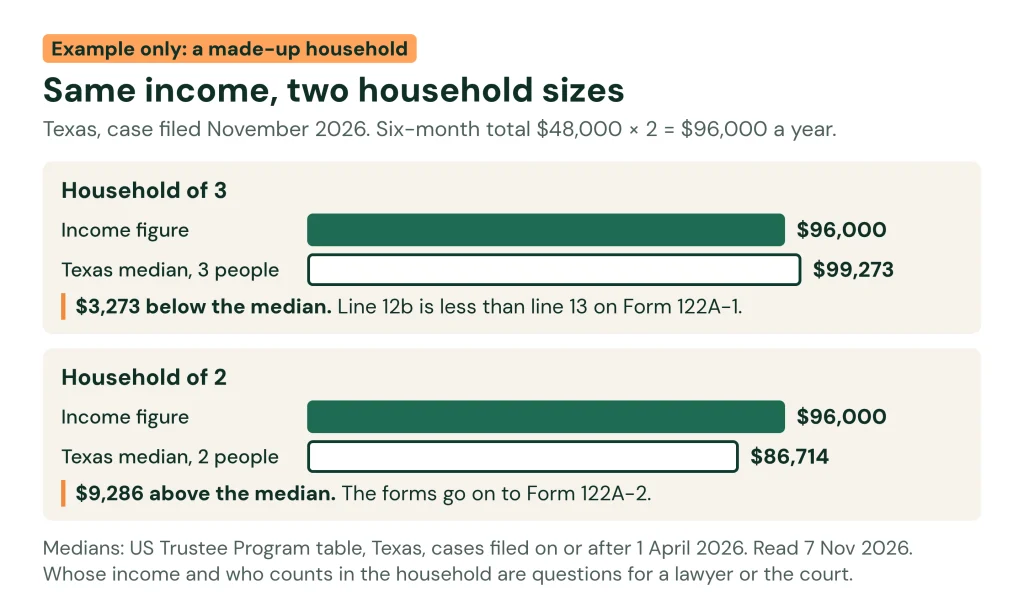
The same income can fall on either side of the line depending on household size and on whose income belongs in the total, so it’s worth getting those two right before reading anything into the comparison.
Next step
- Gather pay stubs and records of every other source of income for the six full calendar months before the month you expect to file, plus your most recent tax return and a list of everyone in your household.
- Read Official Form 122A-1 and the instructions on uscourts.gov, and open the US Trustee’s median income table to check the figure for the date you file.
- Ask the bankruptcy court clerk or the court’s self-help pages about local procedure (they can’t give legal advice), legal aid or a law school clinic, or a bankruptcy lawyer, especially on who counts in your household and whose income belongs in the total.
- What can’t wait: a foreclosure sale date, a lawsuit or a wage garnishment. Those have their own deadlines, and a lawyer or legal aid can tell you what applies.
Sources checked on 7 November 2026: the US Trustee Program’s means testing page and median family income tables (current and earlier periods), 11 U.S.C. 101, 707, 1322 and 1325 at uscode.house.gov (current through Public Law 119-138), 90 FR 8941, Official Form 122A-1 and the instructions for individuals at uscourts.gov, 28 U.S.C. 1930(f) and the HHS 2026 poverty guidelines.
Formulas and sources
- Place code (1 to 50 states, 51 DC, 52 to 55 territories): Arithmetic on the reader's own entries, no outside figure
- Table column 1 (1 earner), places 1 to 19: US Trustee Program, Census Bureau median family income by family size, cases filed on or after 1 April 2026 (table republished for 15 July 2026)
- Table column 1 (1 earner), places 20 to 38: US Trustee Program, Census Bureau median family income by family size, cases filed on or after 1 April 2026 (table republished for 15 July 2026)
- Table column 1 (1 earner), places 39 to 55: US Trustee Program, Census Bureau median family income by family size, cases filed on or after 1 April 2026 (table republished for 15 July 2026)
- Table median for 1 earner: US Trustee Program, Census Bureau median family income by family size, cases filed on or after 1 April 2026 (table republished for 15 July 2026)
- Table column 2 (2 people), places 1 to 19: US Trustee Program, Census Bureau median family income by family size, cases filed on or after 1 April 2026 (table republished for 15 July 2026)
- Table column 2 (2 people), places 20 to 38: US Trustee Program, Census Bureau median family income by family size, cases filed on or after 1 April 2026 (table republished for 15 July 2026)
- Table column 2 (2 people), places 39 to 55: US Trustee Program, Census Bureau median family income by family size, cases filed on or after 1 April 2026 (table republished for 15 July 2026)
- Table median for 2 people: US Trustee Program, Census Bureau median family income by family size, cases filed on or after 1 April 2026 (table republished for 15 July 2026)
- Table column 3 (3 people), places 1 to 19: US Trustee Program, Census Bureau median family income by family size, cases filed on or after 1 April 2026 (table republished for 15 July 2026)
- Table column 3 (3 people), places 20 to 38: US Trustee Program, Census Bureau median family income by family size, cases filed on or after 1 April 2026 (table republished for 15 July 2026)
- Table column 3 (3 people), places 39 to 55: US Trustee Program, Census Bureau median family income by family size, cases filed on or after 1 April 2026 (table republished for 15 July 2026)
- Table median for 3 people: US Trustee Program, Census Bureau median family income by family size, cases filed on or after 1 April 2026 (table republished for 15 July 2026)
- Table column 4 (4 people), places 1 to 19: US Trustee Program, Census Bureau median family income by family size, cases filed on or after 1 April 2026 (table republished for 15 July 2026)
- Table column 4 (4 people), places 20 to 38: US Trustee Program, Census Bureau median family income by family size, cases filed on or after 1 April 2026 (table republished for 15 July 2026)
- Table column 4 (4 people), places 39 to 55: US Trustee Program, Census Bureau median family income by family size, cases filed on or after 1 April 2026 (table republished for 15 July 2026)
- Table median for 4 people: US Trustee Program, Census Bureau median family income by family size, cases filed on or after 1 April 2026 (table republished for 15 July 2026)
- Highest median for 2 or fewer: 11 U.S.C. 707(b)(7)(A): highest median for the same number or fewer; $925 a month per person over 4 (90 FR 8941)
- Highest median for 3 or fewer: 11 U.S.C. 707(b)(7)(A): highest median for the same number or fewer; $925 a month per person over 4 (90 FR 8941)
- Highest median for 4 or fewer: 11 U.S.C. 707(b)(7)(A): highest median for the same number or fewer; $925 a month per person over 4 (90 FR 8941)
- Added for people over 4: $11,100 a year each: 11 U.S.C. 707(b)(7)(A): highest median for the same number or fewer; $925 a month per person over 4 (90 FR 8941)
- Median that applies to this state and household size, per year: 11 U.S.C. 707(b)(7)(A): highest median for the same number or fewer; $925 a month per person over 4 (90 FR 8941)
- The same median per month: Arithmetic on the reader's own entries, no outside figure
- Six-month gross income total entered, times 2: Arithmetic on the reader's own entries, no outside figure
- Annualised figure entered minus the median: Arithmetic on the reader's own entries, no outside figure
- Added per person over 4, per year ($925 a month x 12) (11100, as of 2026-11-07): US Trustee median table footnote: add $11,100 for each individual in excess of 4
Sources
- US Trustee Program, median family income by family size (cases filed on or after 15 July 2026; medians in force from 1 April 2026)
- US Trustee Program, Means Testing
- US Trustee Program, Census and IRS data for cases filed on or after 15 July 2026
- US Trustee Program, median table for cases filed 1 Nov 2025 to 31 Mar 2026
- US Trustee Program, median table for cases filed 15 May to 31 Oct 2025
- US Trustee Program, HAVEN Act questions and answers
- 11 U.S.C. 101 (definitions: 8, 10A, 39A)
- 11 U.S.C. 707
- 11 U.S.C. 1322
- 11 U.S.C. 1325
- Judicial Conference, adjustment of dollar amounts, 90 FR 8941 (4 Feb 2025)
- Official Form 122A-1, Chapter 7 Statement of Your Current Monthly Income
- Official Form 122A-2, Chapter 7 Means Test Calculation
- Instructions, Bankruptcy Forms for Individuals (April 2025)
- 28 U.S.C. 1930
- HHS ASPE, 2026 poverty guidelines