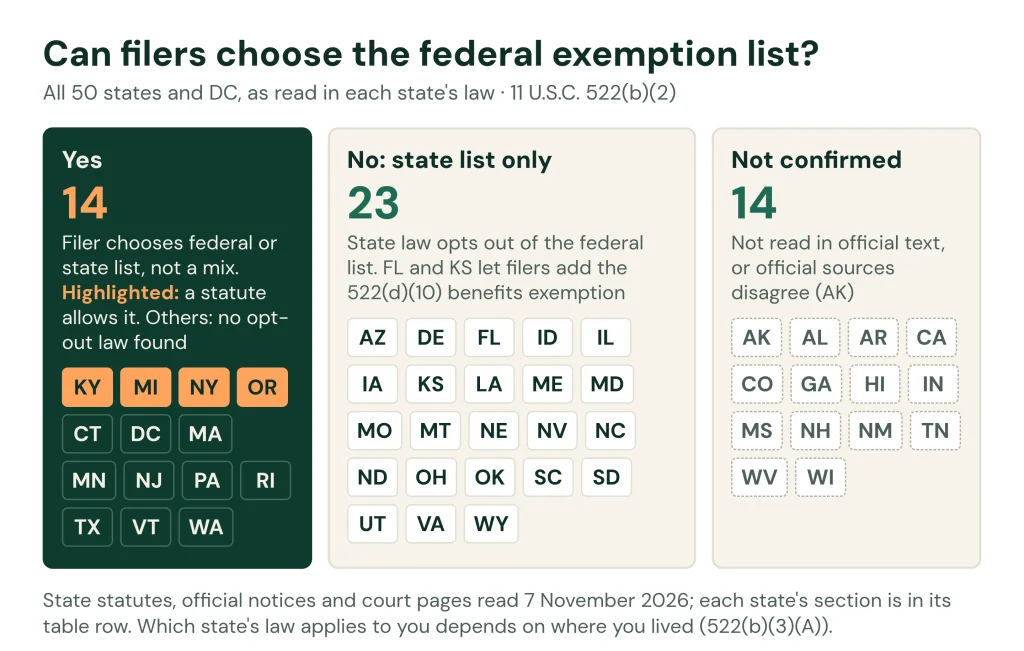
An exemption is a law that lets a person filing bankruptcy protect property, up to a limit, from being sold by the trustee to pay creditors (our guides to what you keep in bankruptcy explain how). Which limits apply depends on the state you have lived in: 23 states don’t let filers use the federal list, 14 jurisdictions do, and for 14 we have not confirmed the answer in official text (in Alaska, the statute and the bankruptcy court’s own table disagree). The state homestead figures we read run from $5,000 in Kentucky to no dollar limit at all in Florida, Texas, Iowa, Kansas, Oklahoma and DC (all but DC limit the land area instead); Pennsylvania and New Jersey have no general homestead exemption. Where it is allowed, the federal list protects up to $31,575 in a home and $5,025 in one vehicle for cases filed on or after 1 April 2025.
This page is general information, not legal, tax or financial advice, and not a substitute for the advice of an attorney. Bankruptcy law and exemption amounts vary by state and change. Ask a bankruptcy lawyer, legal aid or the court about your situation.
Below are a lookup, a summary table and a section for each of the 50 states and DC: whether the federal list is allowed, and the homestead, vehicle and wildcard figures in force, each with its statute and the date we read it. Where we could not read a state’s law in the official text, the row says “not confirmed” and links the state’s code instead of guessing. Our other guides on what you keep go deeper on the house, the car and particular states.
How the lookup works
Choose a state, or tick the box for Washington, DC. The lookup shows four things, the same as that state’s section below the table:
- Federal list allowed? 1 means the state lets filers choose the federal list in 11 U.S.C. 522(d) instead of the state list; 0 means it doesn’t; 2 means we have not confirmed it.
- Homestead: the protection for equity in the home you live in. A type number and a dollar figure: 1 is a dollar figure; 2 means the law sets no dollar limit (most of these states limit the land area instead); 3 means there is no homestead exemption; 4 means the figure is our calculation from the statute’s own formula; 5 means it depends on something like the county, which state list you use or whether a homestead is claimed, so read the table row; 0 means not confirmed.
- Vehicle: a separate exemption for a car or other motor vehicle, with the same type numbers. 3 means there is no separate vehicle exemption, so a car can only be covered by another one, such as a wildcard.
- Wildcard: an amount that can be put toward any property, or any personal property, the law names. Same type numbers. Florida’s and New York’s show type 5 because their wildcard is available only to a filer who claims no homestead exemption.
Where a figure has tiers (an older filer, a household, a second car), the lookup shows the general figure and the state’s section gives the rest, including the debts a homestead does not protect against. The lookup reads the law. It doesn’t value your property, decide which state’s law applies to you, or say what you would keep. Those turn on facts and on the court.
Exemptions by state: federal choice, homestead, vehicle and wildcard
“Equity” is the property’s value minus what is owed on it, such as a mortgage or car loan. Exemption figures are amounts of equity unless the state’s section says otherwise (Massachusetts and Hawaii value vehicles at wholesale, for example). State sections say “the code prints” where a state adjusts its amounts for inflation and the statute text still shows the old figure. Homestead laws also list debts the exemption does not protect against, such as mortgages, taxes and debts for buying or improving the home, and some of those we read (Iowa, Kentucky, Rhode Island and Vermont) also leave out debts that existed before the home was acquired. Each state’s section gives the main conditions we read; the linked statute has the full list, and how a state’s exceptions work in a bankruptcy case is a question for a lawyer or the court.
| State | Federal list? | Home | Car | Wildcard |
|---|---|---|---|---|
| Alabama | – | $18,800 | – | $9,400 |
| Alaska | – | $72,900 | $4,050 | None |
| Arizona | No | $437,600* | $16,500* | None |
| Arkansas | – | – | – | – |
| California | – | 2 lists | $8,625 | $1,950 |
| Colorado | – | – | – | – |
| Connecticut | Yes | $250,000 | $7,000 | $1,000 |
| Delaware | No | $200,000 | $25,000 | $25,000 |
| District of Columbia | Yes | No cap | $2,575 | $850 |
| Florida | No | No cap | $5,000 | $4,000 |
| Georgia | – | $50,000 | – | – |
| Hawaii | – | $20,000 | $2,575 | None |
| Idaho | No | $175,000 | $10,000 | $1,500 |
| Illinois | No | $50,000 | $3,600 | $4,000 |
| Indiana | – | – | – | – |
| Iowa | No | No cap | $7,000 | $1,000 |
| Kansas | No | No cap | $20,000 | None |
| Kentucky | Yes | $5,000 | $2,500 | $1,000 |
| Louisiana | No | $35,000 | $15,000 | None |
| Maine | No | $94,300 | $11,800 | $600 |
| Maryland | No | $31,575 | None | $6,000 |
| Massachusetts | Yes | $125,000 | $7,500 | $1,000 |
| Michigan | Yes | $51,150 | $4,725 | None |
| Minnesota | Yes | $540,000 | $10,200 | $1,650 |
| Mississippi | – | – | – | – |
| Missouri | No | $15,000 | $3,000 | $600 |
| Montana | No | – | $4,000 | None |
| Nebraska | No | $120,000 | $5,970 | $5,970 |
| Nevada | No | $605,000 | $15,000 | $10,000 |
| New Hampshire | – | – | – | – |
| New Jersey | Yes | None | None | $1,000 |
| New Mexico | – | – | – | – |
| New York | Yes | By county | $5,500 | $1,325 |
| North Carolina | No | $35,000 | $3,500 | $5,000 |
| North Dakota | No | $150,000 | $10,000 | $7,500 |
| Ohio | No | $182,625 | $5,025 | $1,675 |
| Oklahoma | No | No cap | $7,500 | None |
| Oregon | Yes | $158,300 | $10,000 | $400 |
| Pennsylvania | Yes | None | None | $300 |
| Rhode Island | Yes | $500,000 | $12,000 | $6,500 |
| South Carolina | No | $80,125 | $8,000 | $8,000 |
| South Dakota | No | No cap | None | $7,000 |
| Tennessee | – | – | – | – |
| Texas | Yes | No cap | In $100k cap | None |
| Utah | No | $53,700 | $3,000 | None |
| Vermont | Yes | $125,000 | $2,500 | $400 |
| Virginia | No | $50,000 | $10,000 | $5,000 |
| Washington | Yes | $125,000+ | $15,000 | $10,000 |
| West Virginia | – | $35,000 | $7,500 | $800 |
| Wisconsin | – | – | – | – |
| Wyoming | No | $100,000 | $5,000 | None |
Each state in full
Tap a state to open its full rules: every figure with its dates and conditions, the statute section, and the date we read it.
Alabama: federal list: not confirmed · homestead: $18,800
- Federal list allowed? Not confirmed: we have not read the opt-out section, Code of Alabama 6-10-11
- Homestead: $18,800 (claims from 1 April 2024); $56,400 if 62 or older or disabled, from 1 June 2026 (Act 2026-203); up to 160 acres; each joint owner can claim it separately. Code 6-10-2 as amended by Act 2026-203
- Vehicle: Not confirmed: no separate vehicle figure on the court’s table
- Wildcard: $9,400 personal property (6-10-6, from 1 April 2024)
- Official text: Alabama statute or notice we read, read 7 Nov 2026
Alaska: federal list: not confirmed · homestead: $72,900
- Federal list allowed? Not confirmed: the statute (AS 09.38.055) allows only Alaska’s list in bankruptcy, but the District of Alaska bankruptcy court’s exemption table says filers may take either list (court table, read 7 Nov 2026); ask the court’s clerk or a lawyer
- Homestead: $72,900 (8 AAC 95.030(a); the statute prints $54,000); co-owners share one amount per home
- Vehicle: $4,050, only if the vehicle’s full value is $27,000 or less (8 AAC 95.030(b))
- Wildcard: None
- Official text: Alaska statute or notice we read, read 7 Nov 2026
Arizona: federal list: No · homestead: $437,600*
- Federal list allowed? No (A.R.S. 33-1133(B))
- Homestead: Statute: $400,000, raised each 1 January by CPI (33-1101(D)). For 2026, $437,600 by our calculation; no official table found
- Vehicle: Statute: $15,000 ($25,000 if the debtor or a dependant has a physical disability), indexed the same way (33-1125(8)). For 2026, $16,500 by our calculation; with a disability $27,400 or $27,500, depending on how the yearly rounding is applied
- Wildcard: None (a separate $5,000 bank account exemption before indexing, 33-1126)
- Official text: Arizona statute or notice we read, read 7 Nov 2026
Arkansas: not confirmed yet
- Federal list allowed? Not confirmed
- Homestead: Not confirmed
- Vehicle: Not confirmed
- Wildcard: Not confirmed
- Official text: not read by us. The state’s code: Arkansas official code
California: federal list: not confirmed · homestead: 2 lists
- Federal list allowed? Not confirmed: we could not open the opt-out section, CCP 703.130, in the official code. California has two state lists: 704 and 703.140(b)
- Homestead: Two lists. 703.140(b)(1): $36,750 (from 1 April 2025). 704.730 homestead: not confirmed
- Vehicle: $8,625 on either list (703.140(b)(2), 704.010; from 1 April 2025)
- Wildcard: 703.140(b)(5) list only: $1,950 plus any unused part of (b)(1); none on the 704 list
- Official text: California statute or notice we read, read 7 Nov 2026
Colorado: not confirmed yet
- Federal list allowed? Not confirmed
- Homestead: Not confirmed in the current code (see the notes on unconfirmed states below)
- Vehicle: Not confirmed
- Wildcard: Not confirmed
- Official text: not read by us. The state’s code: Colorado official code
Connecticut: federal list: Yes · homestead: $250,000
- Federal list allowed? Yes: we found no opt-out in chapter 906 (an absence, not a statute)
- Homestead: $250,000 (52-352b(21)), for bankruptcies filed from 1 October 2021; $75,000 against some abuse and misconduct judgments
- Vehicle: $7,000 for up to two vehicles in total (52-352b(10))
- Wildcard: $1,000 any property (52-352b(18))
- Official text: Connecticut statute or notice we read, read 7 Nov 2026
Delaware: federal list: No · homestead: $200,000
- Federal list allowed? No (10 Del. C. 4914(a))
- Homestead: $200,000 principal residence, one amount per case even in a joint case (4914(c)(1), (d))
- Vehicle: $25,000 for a vehicle and $25,000 for tools of the trade, each per debtor (4914(c)(2), (d))
- Wildcard: $25,000 personal property or real estate other than the home, per debtor (4914(b))
- Official text: Delaware statute or notice we read, read 7 Nov 2026
District of Columbia: federal list: Yes · homestead: No cap
- Federal list allowed? Yes: we found no opt-out (an absence, not a statute)
- Homestead: Residence or co-op: no dollar limit in the text (15-501(a)(14)); mortgages, deeds of trust, mechanic’s and tax liens are not affected. Section 15-501(a), which also sets the vehicle and wildcard figures in this row, is written for the property of a “head of a family or householder”; how that applies to a filer who lives alone is not confirmed
- Vehicle: $2,575 (15-501(a)(1))
- Wildcard: $850 plus up to $8,075 of the unused residence exemption (15-501(a)(3))
- Official text: District of Columbia statute or notice we read, read 7 Nov 2026
Florida: federal list: No · homestead: No cap
- Federal list allowed? No (Fla. Stat. 222.20), but 222.201 lets filers add the federal benefits list, 522(d)(10)
- Homestead: No dollar limit: up to 1/2 acre in a municipality, 160 contiguous acres outside (Fla. Const. art. X s. 4)
- Vehicle: $5,000 (222.25(1))
- Wildcard: $4,000 only if no homestead exemption is claimed or received (222.25(4)); plus $1,000 personal property in the Constitution
- Official text: Florida statute or notice we read, read 7 Nov 2026
Georgia: federal list: not confirmed · homestead: $50,000
- Federal list allowed? Not confirmed: the opt-out (44-13-100(b)) read only in an unofficial copy
- Homestead: $50,000 from 1 July 2026; $100,000 where the home is titled to one spouse who is a debtor and is both spouses’ main home (O.C.G.A. 44-13-100(a)(1) as amended by HB 1024, per the M.D. Ga. bankruptcy court’s notice)
- Vehicle: Not confirmed
- Wildcard: Not confirmed
- Official text: Georgia statute or notice we read, read 7 Nov 2026
Hawaii: federal list: not confirmed · homestead: $20,000
- Federal list allowed? Not confirmed: we have not read a Hawaii statute either way
- Homestead: $20,000; $30,000 for a head of family or a person 65 or older; one exemption per parcel (HRS 651-92)
- Vehicle: $2,575 wholesale value (HRS 651-121(2))
- Wildcard: None in HRS 651-121
- Official text: Hawaii statute or notice we read, read 7 Nov 2026
Idaho: federal list: No · homestead: $175,000
- Federal list allowed? No (Idaho Code 11-609)
- Homestead: $175,000, any area (55-1003)
- Vehicle: $10,000, one vehicle (11-605(3))
- Wildcard: $1,500 tangible personal property (11-605(10))
- Official text: Idaho statute or notice we read, read 7 Nov 2026
Illinois: federal list: No · homestead: $50,000
- Federal list allowed? No (735 ILCS 5/12-1201)
- Homestead: $50,000 from 1 January 2026; two or more owners each get their share of $100,000 by percentage owned (12-901)
- Vehicle: $3,600, one vehicle (12-1001(c))
- Wildcard: $4,000 any other property, of which $1,000 is the automatic bank exemption (12-1001(b))
- Official text: Illinois statute or notice we read, read 7 Nov 2026
Indiana: not confirmed yet
- Federal list allowed? Not confirmed
- Homestead: Not confirmed
- Vehicle: Not confirmed
- Wildcard: Not confirmed
- Official text: not read by us. The state’s code: Indiana official code
Iowa: federal list: No · homestead: No cap
- Federal list allowed? No (Iowa Code 627.10)
- Homestead: No dollar limit: up to 1/2 acre in a city plat, 40 acres elsewhere; one per household (561.2, 561.16). The home can still be sold for debts contracted before it was acquired, if the owner’s other property doesn’t cover them (561.21(1))
- Vehicle: $7,000, one vehicle (627.6(9))
- Wildcard: $1,000 cash, deposits or any personal property (627.6(14))
- Official text: Iowa statute or notice we read, read 7 Nov 2026
Kansas: federal list: No · homestead: No cap
- Federal list allowed? No (K.S.A. 60-2312(a)), but the federal benefits list, 522(d)(10), may be added (60-2312(b))
- Homestead: No dollar limit: 160 acres of farmland or 1 acre in a town or city (60-2301)
- Vehicle: $20,000, one vehicle; no limit for a vehicle designed or equipped for a disability (60-2304(c))
- Wildcard: None
- Official text: Kansas statute or notice we read, read 7 Nov 2026
Kentucky: federal list: Yes · homestead: $5,000
- Federal list allowed? Yes (KRS 427.170)
- Homestead: $5,000; not against a debt that existed before the home was bought (427.060)
- Vehicle: $2,500, one vehicle (427.010(1))
- Wildcard: $1,000, bankruptcy only (427.160)
- Official text: Kentucky statute or notice we read, read 7 Nov 2026
Louisiana: federal list: No · homestead: $35,000
- Federal list allowed? No (R.S. 13:3881(B)(1))
- Homestead: $35,000; full value against debts from a catastrophic or terminal illness or injury; up to 5 acres in a municipality, 200 outside (R.S. 20:1)
- Vehicle: $15,000 equity, one vehicle, from 1 August 2026 (Act 55 of 2026); a second $15,000 vehicle in some households (13:3881(A)(7))
- Wildcard: None in 13:3881
- Official text: Louisiana statute or notice we read, read 7 Nov 2026
Maine: federal list: No · homestead: $94,300
- Federal list allowed? No (14 M.R.S. 4426)
- Homestead: $94,300; $188,550 with minor dependants at home, or if the filer or a dependant is 60 or older or disabled; lower caps for joint owners (4422(1); SJC order JB-24-02, from 24 Oct 2024)
- Vehicle: $11,800 (4422(2), adjusted)
- Wildcard: $600 any property, plus up to $12,400 of unused residence exemption for listed items (4422(15), (16), adjusted)
- Official text: Maine statute or notice we read, read 7 Nov 2026
Maryland: federal list: No · homestead: $31,575
- Federal list allowed? No (Cts. & Jud. Proc. 11-504(g))
- Homestead: Bankruptcy only: the federal 522(d)(1) amount, now $31,575; not if the filer or a close relative successfully claimed it on the same home within 8 years; not by both spouses in one case (11-504(f))
- Vehicle: None separate
- Wildcard: $6,000 cash or any property (11-504(b)(6)), plus $5,000 personal property in bankruptcy (11-504(f)(1)(i)1)
- Official text: Maryland statute or notice we read, read 7 Nov 2026
Massachusetts: federal list: Yes · homestead: $125,000
- Federal list allowed? Yes: we found no opt-out (an absence, not a statute)
- Homestead: $125,000 automatic; $1,000,000 with a recorded declaration (G.L. c. 188 s. 1)
- Vehicle: $7,500 wholesale value; $15,000 if handicapped or 60 or older (c. 235 s. 34, Sixteenth)
- Wildcard: $1,000 plus up to $5,000 of unused furniture, tools and vehicle amounts (Seventeenth)
- Official text: Massachusetts statute or notice we read, read 7 Nov 2026
Michigan: federal list: Yes · homestead: $51,150
- Federal list allowed? Yes: MCL 600.5451(1) sets out the state list as an alternative, and we found no opt-out
- Homestead: $51,150; $76,725 if the filer or a dependant is 65 or older or disabled; cases filed from 1 April 2026; the statute applies the limit to “the interest of the debtor, the codebtor, if any, and the debtor’s dependents” (MCL 600.5451(1)(m); Treasury notice of 30 Jan 2026)
- Vehicle: $4,725, one vehicle (600.5451(1)(g); same notice)
- Wildcard: None
- Official text: Michigan statute or notice we read, read 7 Nov 2026
Minnesota: federal list: Yes · homestead: $540,000
- Federal list allowed? Yes: we found no opt-out (an absence, not a statute)
- Homestead: $540,000; $1,350,000 if mainly agricultural; one amount per homestead however many debtors claim it (510.02, from 1 July 2026; next adjustment due 1 July 2028)
- Vehicle: $10,200 (550.37 subd. 12a(1))
- Wildcard: $1,650, bankruptcy only (550.37 subd. 28)
- Official text: Minnesota statute or notice we read, read 7 Nov 2026
Mississippi: not confirmed yet
- Federal list allowed? Not confirmed
- Homestead: Not confirmed
- Vehicle: Not confirmed
- Wildcard: Not confirmed
- Official text: not read by us. The state’s code: Mississippi official code
Missouri: federal list: No · homestead: $15,000
- Federal list allowed? No (RSMo 513.427)
- Homestead: $15,000 until 31 Dec 2026; $40,000 from 1 Jan 2027 (513.475); not allowed to a second owner if one owner claims the whole amount
- Vehicle: $3,000 total until 31 Dec 2026; from 1 Jan 2027, $5,000 plus up to $10,000 of the unused household goods amount (513.430(5))
- Wildcard: $600 until 31 Dec 2026; $1,700 from 1 Jan 2027 (513.430(3)); a head of family may add more (513.440)
- Official text: Missouri statute or notice we read, read 7 Nov 2026
Montana: federal list: No · homestead: not confirmed
- Federal list allowed? No (MCA 31-2-106)
- Homestead: Not confirmed: set by Revenue rule, $350,000 in 2021 plus 4% a year (70-32-104(3)); the 2026 rule figure not read
- Vehicle: $4,000, one vehicle (25-13-609(2))
- Wildcard: None
- Official text: Montana statute or notice we read, read 7 Nov 2026
Nebraska: federal list: No · homestead: $120,000
- Federal list allowed? No (Neb. Rev. Stat. 25-15,105)
- Homestead: $120,000; up to 160 acres outside a city or two lots inside (40-101)
- Vehicle: $5,970 for 2023-2027 (25-1556; statute $5,000; Revenue Ruling 2023-1)
- Wildcard: $5,970 personal property, not wages (25-1552; same ruling)
- Official text: Nebraska statute or notice we read, read 7 Nov 2026
Nevada: federal list: No · homestead: $605,000
- Federal list allowed? No (NRS 21.090(3))
- Homestead: $605,000 equity; all equity with allodial title (NRS 115.010). The statute has the homestead selected by a signed, recorded declaration (NRS 115.020)
- Vehicle: $15,000 equity, one vehicle; no limit for one adapted for a disability (21.090(1)(f), (p))
- Wildcard: $10,000 any personal property, including bank deposits (21.090(1)(z))
- Official text: Nevada statute or notice we read, read 7 Nov 2026
New Hampshire: not confirmed yet
- Federal list allowed? Not confirmed
- Homestead: Not confirmed
- Vehicle: Not confirmed
- Wildcard: Not confirmed
- Official text: not read by us. The state’s code: New Hampshire official code
New Jersey: federal list: Yes · homestead: None
- Federal list allowed? Yes: we found no opt-out (an absence, not a statute)
- Homestead: None in general. Veterans, service members and military spouses: primary and one secondary residence, no value limit, with exceptions (N.J.S.A. 2A:17-17.4)
- Vehicle: None in general (veterans and the others above: $30,000, one per household, 2A:17-17.5)
- Wildcard: $1,000 personal property, plus all clothing (2A:17-19)
- Official text: New Jersey statute or notice we read, read 7 Nov 2026
New Mexico: not confirmed yet
- Federal list allowed? Not confirmed
- Homestead: Not confirmed (see the notes on unconfirmed states below)
- Vehicle: Not confirmed
- Wildcard: Not confirmed
- Official text: not read by us. The state’s code: New Mexico official code
New York: federal list: Yes · homestead: By county
- Federal list allowed? Yes (Debtor and Creditor Law 285)
- Homestead: By county, 1 April 2024 to 31 March 2027: $204,825 (NYC boroughs, Nassau, Suffolk, Rockland, Westchester, Putnam); $170,700 (Dutchess, Albany, Columbia, Orange, Saratoga, Ulster); $102,400 elsewhere (CPLR 5206(a); DFS table; next adjustment due 1 April 2027)
- Vehicle: $5,500; $13,625 if equipped for a disabled debtor (CPLR 5205(a)(8); DCL 282(1))
- Wildcard: $1,325 only if no homestead is claimed (5205(a)(9)); DCL 283(2) cash up to $6,825 in some cases
- Official text: New York statute or notice we read, read 7 Nov 2026
North Carolina: federal list: No · homestead: $35,000
- Federal list allowed? No (G.S. 1C-1601(f))
- Homestead: $35,000; $60,000 for an unmarried filer 65 or older whose co-owner has died (1C-1601(a)(1))
- Vehicle: $3,500, one vehicle (1C-1601(a)(3))
- Wildcard: Up to $5,000 of the unused homestead amount, any property (1C-1601(a)(2))
- Official text: North Carolina statute or notice we read, read 7 Nov 2026
North Dakota: federal list: No · homestead: $150,000
- Federal list allowed? No (N.D.C.C. 28-22-17)
- Homestead: $150,000 over liens (47-18-01); or $25,000 in place of the homestead (28-22-03.1(1))
- Vehicle: $10,000, one vehicle; $50,000 if modified for a disability (28-22-03.1(2))
- Wildcard: $7,500 for a head of family (28-22-03); $3,750 for an unmarried person without dependants (28-22-05)
- Official text: North Dakota statute or notice we read, read 7 Nov 2026
Ohio: federal list: No · homestead: $182,625
- Federal list allowed? No (R.C. 2329.662)
- Homestead: $182,625 for cases filed 1 April 2025 to 31 March 2028 (2329.66(A)(1); the code prints $125,000)
- Vehicle: $5,025 (2329.66(A)(2); the code prints $3,225)
- Wildcard: $1,675 any property, bankruptcy only (2329.66(A)(18); the code prints $1,075)
- Official text: Ohio statute or notice we read, read 7 Nov 2026
Oklahoma: federal list: No · homestead: No cap
- Federal list allowed? No (31 O.S. 1(B))
- Homestead: No dollar limit: 1 acre in a city or town, 160 acres outside; $5,000 cap if more than 25% of the floor area is used for business (31 O.S. 2)
- Vehicle: $7,500, one vehicle (31 O.S. 1(A)(13))
- Wildcard: None
- Official text: Oklahoma statute or notice we read, read 7 Nov 2026
Oregon: federal list: Yes · homestead: $158,300
- Federal list allowed? Yes, either list but not both (ORS 18.300)
- Homestead: $158,300; $316,700 combined when two or more household members are debtors; 1 July 2026 to 30 June 2027, next adjustment 1 July 2027 (ORS 18.395; the statute prints $150,000 / $300,000). Against child or spousal support or restitution judgments: $40,000, or $50,000 combined (18.395(1)(b), not indexed)
- Vehicle: $10,000 (18.345(1)(d))
- Wildcard: $400 any personal property; can’t be used to top up another exemption (18.345(1)(p))
- Official text: Oregon statute or notice we read, read 7 Nov 2026
Pennsylvania: federal list: Yes · homestead: None
- Federal list allowed? Yes: we found no opt-out (an absence, not a statute)
- Homestead: None (the $300 general exemption covers real property too)
- Vehicle: None separate
- Wildcard: $300 any property (42 Pa.C.S. 8123)
- Official text: Pennsylvania statute or notice we read, read 7 Nov 2026
Rhode Island: federal list: Yes · homestead: $500,000
- Federal list allowed? Yes: we found no opt-out (an absence, not a statute)
- Homestead: $500,000, automatic; one homestead per family. Not against, among others, debts contracted before the homestead was acquired, debts for buying the home, support orders, or debts owed to a federally insured bank or a lender licensed under RI title 19 (9-26-4.1(a))
- Vehicle: $12,000 for all vehicles (9-26-4(13))
- Wildcard: $6,500 any assets, bankruptcy only (9-26-4(16))
- Official text: Rhode Island statute or notice we read, read 7 Nov 2026
South Carolina: federal list: No · homestead: $80,125
- Federal list allowed? No (S.C. Code 15-41-35)
- Homestead: $80,125; $160,250 cap per living unit; from 1 July 2026, adjusted every even-numbered year (15-41-30(A)(1), (B); State Register notice; the code prints $50,000 / $100,000)
- Vehicle: $8,000 (15-41-30(A)(2), adjusted)
- Wildcard: $8,000 of unused exemption amounts (item 7); plus $8,000 cash and liquid assets only if no homestead is claimed (item 5)
- Official text: South Carolina statute or notice we read, read 7 Nov 2026
South Dakota: federal list: No · homestead: No cap
- Federal list allowed? No (SDCL 43-31-30)
- Homestead: No dollar limit in the sections we read: 1 acre in a town plat, 160 acres outside (43-31-4); sale proceeds $100,000 for one year (43-45-3), which also mentions a $170,000 limit for a homestead of a person 70 or older or their unremarried surviving spouse; how that limit applies is not confirmed
- Vehicle: None separate
- Wildcard: $7,000 for a head of family; $5,000 for others (43-45-4)
- Official text: South Dakota statute or notice we read, read 7 Nov 2026
Tennessee: not confirmed yet
- Federal list allowed? Not confirmed
- Homestead: Not confirmed (see the notes on unconfirmed states below)
- Vehicle: Not confirmed
- Wildcard: Not confirmed
- Official text: not read by us. The state’s code: Tennessee official code
Texas: federal list: Yes · homestead: No cap
- Federal list allowed? Yes: we found no opt-out in Property Code chs. 41-42 (an absence, not a statute)
- Homestead: No dollar limit: up to 10 acres in a city or town; 200 acres rural for a family, 100 for a single adult (Prop. Code 41.002)
- Vehicle: One vehicle per licensed family member, inside the personal property cap of $100,000 for a family, $50,000 for a single adult (42.001, 42.002)
- Wildcard: None
- Official text: Texas statute or notice we read, read 7 Nov 2026
Utah: federal list: No · homestead: $53,700
- Federal list allowed? No (Utah Code 78B-5-513; filers who were nonresidents for the 180 days before filing excepted)
- Homestead: $53,700 primary residence, $107,500 per household, in 2026; the Auditor publishes new figures each January (78B-5-503(2); State Auditor notice; the code prints $42,000 / $84,000)
- Vehicle: $3,000, one vehicle (78B-5-506(3))
- Wildcard: None in 78B-5-503, -505 or -506
- Official text: Utah statute or notice we read, read 7 Nov 2026
Vermont: federal list: Yes · homestead: $125,000
- Federal list allowed? Yes: we found no opt-out (an absence, not a statute)
- Homestead: $125,000 (27 V.S.A. 101); not against debts that existed when the deed was recorded (27 V.S.A. 107)
- Vehicle: $2,500 for all vehicles (12 V.S.A. 2740(1))
- Wildcard: $400 plus up to $7,000 of unused amounts for vehicles, tools, jewellery, household goods and crops (2740(7))
- Official text: Vermont statute or notice we read, read 7 Nov 2026
Virginia: federal list: No · homestead: $50,000
- Federal list allowed? No (Va. Code 34-3.1)
- Homestead: $50,000 principal residence (34-4); first CPI adjustment 1 April 2027
- Vehicle: $10,000 for all vehicles (34-26(8))
- Wildcard: $5,000 ($10,000 if 65 or older), plus $500 per dependant (34-4)
- Official text: Virginia statute or notice we read, read 7 Nov 2026
Washington: federal list: Yes · homestead: $125,000+
- Federal list allowed? Yes: we found no opt-out; RCW 6.13.080(3) refers to a spouse using 522(d)
- Homestead: The greater of $125,000 or the county’s median single-family sale price in the year before (RCW 6.13.030); county figures not confirmed. Not available against child support or maintenance debts (6.13.080(4))
- Vehicle: $15,000 (6.15.010(1)(d)(iv))
- Wildcard: $10,000 other personal property, bankruptcy only (6.15.010(1)(d)(ii))
- Official text: Washington statute or notice we read, read 7 Nov 2026
West Virginia: federal list: not confirmed · homestead: $35,000
- Federal list allowed? Not confirmed (see the notes on unconfirmed states below)
- Homestead: $35,000 (38-10-4(a)); higher for some physicians
- Vehicle: $7,500, one vehicle (38-10-4(b))
- Wildcard: $800 plus any unused homestead amount (38-10-4(e))
- Official text: West Virginia statute or notice we read, read 7 Nov 2026
Wisconsin: not confirmed yet
- Federal list allowed? Not confirmed
- Homestead: Not confirmed
- Vehicle: Not confirmed
- Wildcard: Not confirmed
- Official text: not read by us. The state’s code: Wisconsin official code
Wyoming: federal list: No · homestead: $100,000
- Federal list allowed? No (W.S. 1-20-109)
- Homestead: $100,000; each joint owner who lives there gets one (1-20-101, 1-20-102(b))
- Vehicle: $5,000 (1-20-106(a)(iv))
- Wildcard: None
- Official text: Wyoming statute or notice we read, read 7 Nov 2026
Notes on states that are not fully confirmed
- Arkansas, Indiana, Mississippi, New Hampshire and Wisconsin: we could not read the official statute text from our systems (Arkansas and Mississippi publish their codes through a commercial viewer; the Indiana, New Hampshire and Wisconsin statute sites did not load for us on 7 November 2026). Every field shows “not confirmed”. Use the link in the state’s section, or ask the bankruptcy court clerk or legal aid where to find the current law.
- Alabama: the amounts come from the U.S. Bankruptcy Court for the Southern District of Alabama’s exemption amounts table and the enrolled text of Act 2026-203, not from the code itself, which we could not open. Whether Alabama allows the federal list is not confirmed.
- Arizona: the statute sets $400,000 for the home and $15,000 for a vehicle and raises them each 1 January by the change in the national consumer price index from August to August, rounded up to the next $100 (A.R.S. 33-1101(D)). We found no official table, so we did the arithmetic with the Bureau of Labor Statistics’ August CPI-U figures (296.171 for 2022, 323.976 for 2025): $400,000 × 323.976 ÷ 296.171 = $437,553, rounded up to $437,600. Working it out year by year gives the same homestead figure and the same $16,500 vehicle figure; the disability vehicle figure comes to $27,400 one way and $27,500 the other. Treat all of these as our calculation, not official figures.
- California: California has two state lists, the 704 list and the 703.140(b) list, which the Judicial Council’s form EJ-156 (revised 20 July 2026) describes as the one used in bankruptcy cases. The 703.140(b) figures and the vehicle figure come from that form. We could not open the California code itself (CCP 703.130 on the federal list, 704.730 on the homestead) in official text, so those two answers are not confirmed.
- Colorado: we read the 2022 law that rewrote the homestead and vehicle exemptions (SB22-086), but not the current Colorado Revised Statutes, so we can’t say whether its amounts are still the ones in force. Every field shows “not confirmed”.
- Georgia: the homestead figure is from the Middle District of Georgia bankruptcy court’s notice of HB 1024, effective 1 July 2026, which says the amount will be adjusted for inflation each year from 1 July 2031. Georgia’s other amounts and its opt-out were read only in an unofficial copy, so they are not confirmed.
- Hawaii: amounts read in the Hawaii Revised Statutes on 7 November 2026. We did not find a Hawaii statute on the federal list either way, so that answer is not confirmed.
- Montana: the homestead limit is set each year by a Department of Revenue rule. The statute says it was $350,000 in 2021 and rises 4% a year (MCA 70-32-104(3)), but we have not read the rule’s 2026 figure.
- New Mexico: we found only a state court claim-of-exemption form last amended in 2009, not the statutes themselves, so we don’t give its figures. Not confirmed.
- Tennessee: we read only the General Assembly’s bill summaries of a 2021 homestead change, not the code text, so we don’t give a figure. Not confirmed.
- Washington: the homestead is the greater of $125,000 or the county’s median single-family sale price in the previous year (RCW 6.13.030). We have not read the county figures.
- West Virginia: W. Va. Code 38-10-4(k) says that “solely for the purpose of applying” 522(b)(2), a debtor domiciled in the state “may exempt” the property in 522(d). Kentucky’s KRS 427.170 uses almost the same words (“is authorized to exempt”), and we list Kentucky as allowing the federal list. We have not found a West Virginia court source on how this subsection is applied, so we show it as not confirmed.
The federal list, where a state allows it
11 U.S.C. 522(b) gives each filer two routes: the federal list in 522(d), or the exemptions of their state plus federal laws outside the Bankruptcy Code. The federal list is available “unless the State law that is applicable to the debtor … specifically does not so authorize” (522(b)(2)), and many states have passed a law saying exactly that. You use one list or the other, not a mix. In the 14 jurisdictions marked “Yes” above, the choice is the filer’s. Ten of them are marked “Yes” because we found no opt-out law, which is an absence rather than a statute saying yes. Kentucky, New York and Oregon have a statute that allows the federal list, and Michigan’s statute sets out its own list as an alternative to federal law. How that choice looks in one state, with homestead amounts by county, is on our New York exemptions page.
The federal amounts are adjusted every three years. These apply to cases filed on or after 1 April 2025 (90 FR 8941; the notes to 11 U.S.C. 522 show the same figures); the next adjustment is due 1 April 2028.
| Federal exemption | Section | Cases filed from 1 April 2025 | Before (from 1 April 2022) |
|---|---|---|---|
| Home or burial plot | 522(d)(1) | $31,575 | $27,900 |
| One motor vehicle | 522(d)(2) | $5,025 | $4,450 |
| Household goods | 522(d)(3) | $800 per item, $16,850 in total | $700 / $14,875 |
| Jewellery | 522(d)(4) | $2,125 | $1,875 |
| Wildcard | 522(d)(5) | $1,675 plus up to $15,800 of unused (d)(1) | $1,475 + $13,950 |
| Tools of the trade | 522(d)(6) | $3,175 | $2,800 |
| Personal injury payment | 522(d)(11)(D) | $31,575 | $27,900 |
The federal list also covers some property without a dollar cap, such as Social Security, unemployment, veterans’ and disability benefits, health aids and tax-exempt retirement accounts. Our page on the federal bankruptcy exemptions goes through every item. A few states that don’t allow the federal list let filers add one piece of it: Florida (Fla. Stat. 222.201; the rest of its list is on our Florida bankruptcy exemptions page) and Kansas (K.S.A. 60-2312(b)) both allow the 522(d)(10) benefits exemption on top of the state list.
Which state’s exemptions apply
It isn’t always the state you live in today. Under 522(b)(3)(A), the state exemptions that apply are those of the place where your domicile (your permanent home) was for the 730 days, about two years, before you file. If you didn’t live in one state for that whole time, it’s the place you lived for the 180 days before that 730-day period, or for the longer part of those 180 days. If that leaves you with no exemptions at all, the statute lets you choose the federal list.
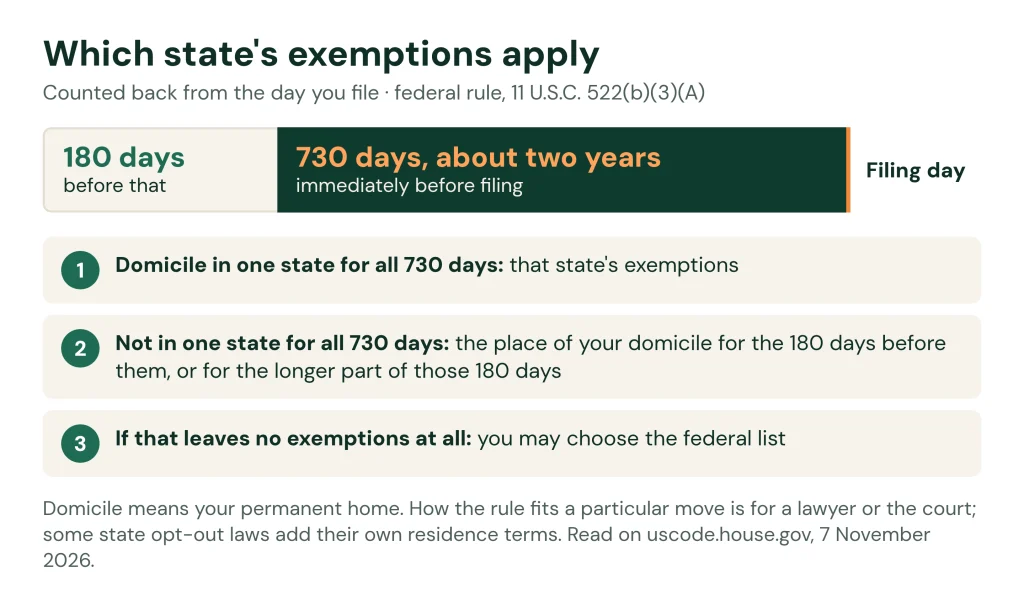
So someone who moved from Texas to Ohio 18 months ago may find that Texas law decides their exemptions even though they file in Ohio. Some states’ opt-out laws are written with movers in mind: Utah’s applies unless the filer was a nonresident for the 180 days before filing (Utah Code 78B-5-513), and Wyoming’s refers to a Wyoming domicile for 180 days (W.S. 1-20-109). How these rules fit together for a particular move is a question for a lawyer or the court; this page doesn’t decide it.
Federal limits that apply in every state
Even a state with no dollar limit on the homestead is subject to these parts of 522, which the state table doesn’t show:
- A home bought in the last 1,215 days (about 3 years and 4 months). A filer using state exemptions can’t exempt more than $214,000 of homestead interest acquired in the 1,215 days before filing (522(p), cases filed from 1 April 2025). Equity moved from a previous home in the same state, bought before that period, doesn’t count toward the limit, and the limit doesn’t apply to a family farmer’s principal residence.
- Certain conduct. The same $214,000 cap applies, except for what is reasonably necessary for support, if the court finds a felony conviction showing the filing was an abuse, or the filer owes debts from securities fraud, fraud in a fiduciary capacity, racketeering, or a crime, intentional tort or wilful or reckless misconduct that caused serious injury or death in the previous 5 years (522(q)).
- Property moved into the home to dodge creditors. The homestead’s value is reduced by any part that came from non-exempt property disposed of in the 10 years before filing with intent to hinder, delay or defraud a creditor (522(o)).
- Debts exempt property still answers for. Exempt property stays liable for some debts, including domestic support and the kinds of taxes that aren’t discharged, and for liens that are not removed in the case, such as a mortgage or a properly filed tax lien (522(c)). An exemption protects equity; it doesn’t erase a loan secured by the property.
- Retirement accounts. Funds in tax-exempt retirement accounts are protected under either system (522(b)(3)(C), (d)(12)). For traditional and Roth IRAs there is a cap of $1,711,975, not counting money rolled over from employer plans, which the court may raise “if the interests of justice so require” (522(n)).

Our guide to keeping a house in bankruptcy explains how the homestead figure, the mortgage and these limits fit together, and the guide to what happens to a car in bankruptcy does the same for vehicles and car loans.
Married couples filing together
Spouses in a joint case must both use the same system; if they can’t agree, they are treated as choosing the federal list where it is allowed (522(b)(1)). Under the federal list, the exemptions apply to each spouse separately (522(m)), which is why a couple filing together can claim two federal homestead amounts. Under a state list, it depends on the state, and many statutes don’t say. In the laws we read:
- One amount per home or case: Delaware’s $200,000 residence limit is per case, individual or joint (10 Del. C. 4914(d)); Minnesota’s applies “whether the exemption is claimed by one or more debtors” (510.02); Rhode Island allows one homestead per family (9-26-4.1); Alaska caps the total for all owners of one home at the single homestead amount (AS 09.38.010(b)); Maryland’s bankruptcy homestead can’t be claimed by both spouses in the same case (11-504(f)(3)); Arizona allows one homestead exemption to a married couple or a single person (A.R.S. 33-1101(B)); in Iowa, people who live together as one household claim only one homestead (561.16); Massachusetts keeps the automatic $125,000 whole between joint tenants or tenants by the entirety (G.L. c. 188 s. 1; the declared exemption has its own rules for co-owners and separate declarations); Washington spouses can’t claim the same home separately to raise its value above the 6.13.030 amount (RCW 6.13.020).
- Shares or combined caps: in Illinois, two or more owners each get their share of $100,000 by percentage owned (12-901); in Oregon, two or more household members who are debtors share a combined $316,700 (ORS 18.395); Utah gives each joint owner an exemption up to a household cap (78B-5-503(2)(b)); in Montana, an owner of an undivided interest gets a share in proportion to that interest (70-32-104(2)).
- Each owner: in Alabama, each owner of a jointly owned homestead can claim the exemption separately (6-10-2, as amended by Act 2026-203); in Wyoming, each joint owner who lives in the home is entitled to the homestead exemption (1-20-102(b)); Delaware applies its other amounts to each debtor in a joint case (4914(d)).
For other states we haven’t read a rule, so don’t assume amounts double. Our page on bankruptcy and your spouse covers filing alone or together.
What an exemption figure does and doesn’t tell you
A figure in the table is the most that law protects for that kind of property, not a statement about anyone’s case. In Chapter 7, the trustee (the official who runs the case) must collect and turn into money the property of the estate (11 U.S.C. 704(a)(1)); property properly claimed as exempt comes out of the estate. In Chapter 13, nothing is sold for this reason, but the plan generally has to pay unsecured creditors at least what they would have got in a Chapter 7 (11 U.S.C. 1325(a)(4)), so exemptions still matter there. The value of property, how much of it is equity, whether a lien can be removed and whether an exemption claim is valid are all things the trustee or a creditor can dispute and the court decides.
Exemptions for wages work differently: they limit how much a creditor can garnish from a paycheck, and states set their own rules on top of the federal floor (15 U.S.C. 1673). Our page on how wage garnishment stops sets out the federal limit and what a bankruptcy filing does to a garnishment.
Figures you may see elsewhere
Many lists online have not caught up with changes in 2024 to 2026. These are the ones we found most often. You may see them on other sites; we checked them against the official text and they are out of date.
- Federal homestead $27,900 and vehicle $4,450: those were for cases filed from 1 April 2022 to 31 March 2025. It is now $31,575 and $5,025.
- Illinois homestead $15,000 and vehicle $2,400: the old law. Since 1 January 2026 it is $50,000 and $3,600 (P.A. 104-120); our guide to the Illinois exemptions after the 2026 change goes through each item.
- Georgia homestead $21,500: raised to $50,000 from 1 July 2026, according to the bankruptcy court’s notice.
- Michigan homestead $46,125: the figure for cases filed from 1 April 2023. For cases filed from 1 April 2026 it is $51,150 (Treasury notice of 30 January 2026).
- Ohio homestead $125,000 and Utah $42,000: the numbers printed in the code. Both are adjusted for inflation: $182,625 in Ohio for cases filed 1 April 2025 to 31 March 2028, and $53,700 in Utah for 2026.
- Louisiana vehicle $7,500: raised to $15,000 from 1 August 2026 (Act 55 of 2026).
- Missouri homestead $40,000: correct only from 1 January 2027. The Missouri revisor’s website already shows the 2027 text by default; for cases filed in 2026 the figure is $15,000.
- Arizona homestead $400,000: the figure printed in the statute. It has been adjusted each 1 January since 2024.
Worked example
This page is general information, not legal, tax or financial advice, and not a substitute for the advice of an attorney. Bankruptcy law and exemption amounts vary by state and change. Ask a bankruptcy lawyer, legal aid or the court about your situation.
The lookup opens on Ohio (the whole Ohio list, with its 2025-28 amounts, is on our Ohio exemptions page). It shows:
- Federal list allowed: 0. Ohio law says the federal list is not authorized (R.C. 2329.662), so an Ohio filer uses the Ohio list in R.C. 2329.66 plus federal laws outside the Bankruptcy Code.
- Homestead: type 1, $182,625. The code prints $125,000; the Ohio Judicial Conference adjusts it every three years, and $182,625 applies to cases filed from 1 April 2025 to 31 March 2028, as the Southern District of Ohio bankruptcy court’s notice of 28 March 2025 lists.
- Vehicle: type 1, $5,025. For one motor vehicle, same period.
- Wildcard: type 1, $1,675. Any property, in bankruptcy only.
Now an example with made-up numbers, to show the arithmetic. Suppose someone in Ohio owns a car worth $9,000 with $6,000 left on the loan. The equity is $9,000 − $6,000 = $3,000, which is below the $5,025 vehicle figure. If the loan were $2,000, the equity would be $7,000, or $1,975 over the vehicle figure, and the wildcard ($1,675) could be put toward that, leaving $300. Whether the trustee accepts the value, and what happens to the remaining $300, are questions for the trustee and the court. Valuations, the costs of a sale and other exemptions all come into it, so treat this as an illustration of the sums, not a prediction.
Pick Texas and the homestead shows type 2 with $0: the law sets no dollar limit, only acreage, though the federal 1,215-day limit above can still apply. The vehicle shows type 5: Texas protects one vehicle for each licensed family member inside an overall personal property cap, so there is no single figure to show. Our Texas exemptions guide sets out the acreage and the personal property cap in full.
How these figures were read
Every figure was read on 7 November 2026 in the state’s official statute text, an official adjustment notice (Maine’s Supreme Judicial Court order, Michigan’s Treasury notice, Nebraska’s Revenue Ruling 2023-1, New York’s Department of Financial Services table, Oregon’s Judicial Department table, South Carolina’s State Register notice, Utah’s State Auditor notice, Minnesota’s Commerce Department table) or a bankruptcy court’s official notice (Alabama, Georgia, Ohio), or California’s Judicial Council form. We did not use law firm pages, legal publishers or bankruptcy service websites for any figure. Where the official text couldn’t be reached, the row says “not confirmed”. Some states change their amounts on 1 January, 1 April or 1 July, so we recheck the table on those dates and after each legislative session.
These figures cover the headline exemptions only. Every state also protects other things, often without a dollar cap: clothing, household goods, tools, public benefits, retirement accounts, insurance and more. The statute linked in each state’s section lists them.
Next step

- Gather a list of everything you own with a rough value for each item, and what you owe on anything that secures a loan: the latest mortgage statement, the car loan payoff, a recent bank statement. Note where you have lived for the last two and a half years.
- Read your state’s row and the statute it links to, and Official Form 106C, the schedule where property is claimed as exempt, on uscourts.gov. A new version of that form takes effect on 1 December 2026.
- Ask the bankruptcy court clerk or the court’s self-help pages about local procedure (they can’t give legal advice), legal aid or a law school clinic, or a bankruptcy lawyer about which state’s law applies to you, how to value your property and whether a married couple’s amounts combine. If you are checking whether your income is under the Chapter 7 limit, the income limits by state show the median that applies.
- Watch the dates on a foreclosure sale, a car repossession or a garnishment while you work this out. Each has its own deadlines, and a lawyer or legal aid can tell you what applies.
Sources checked on 7 November 2026: 11 U.S.C. 522 at uscode.house.gov (current through Public Law 119-138) and 90 FR 8941; the state statutes, adjustment notices and court notices linked in each state’s section; BLS CPI-U August figures for 2022 and 2025 for the Arizona calculation; Louisiana Legislature, HB 135 (2026) status page.
Formulas and sources
- Row number (District of Columbia is 9): Arithmetic on the reader's own entries, no outside figure
- Federal list (11 U.S.C. 522(d)) available: 1 yes, 0 no, 2 not confirmed: State statutes, adjustment notices and court notices listed in the table on this page, read 7 Nov 2026
- Homestead: 1 figure, 2 no dollar cap, 3 none, 4 our calculation, 5 see the table, 0 not confirmed: State statutes, adjustment notices and court notices listed in the table on this page, read 7 Nov 2026
- Homestead figure for the main case (0 when there is no single figure): State statutes, adjustment notices and court notices listed in the table on this page, read 7 Nov 2026
- Vehicle: 1 dollar figure, 3 none separate, 4 our calculation, 5 depends (see the table), 0 not confirmed: State statutes, adjustment notices and court notices listed in the table on this page, read 7 Nov 2026
- Vehicle figure (0 when there is no single figure) (part 1): State statutes, adjustment notices and court notices listed in the table on this page, read 7 Nov 2026
- Vehicle figure (0 when there is no single figure) (part 2): State statutes, adjustment notices and court notices listed in the table on this page, read 7 Nov 2026
- Vehicle figure (0 when there is no single figure): State statutes, adjustment notices and court notices listed in the table on this page, read 7 Nov 2026
- Wildcard: 1 dollar figure, 3 none, 5 depends (see the table), 0 not confirmed: State statutes, adjustment notices and court notices listed in the table on this page, read 7 Nov 2026
- Wildcard figure, main amount only (0 when there is no single figure): State statutes, adjustment notices and court notices listed in the table on this page, read 7 Nov 2026
Sources
- 11 U.S.C. 522 (uscode.house.gov, current through Pub. L. 119-138)
- Judicial Conference, revision of certain dollar amounts in the Bankruptcy Code, 90 FR 8941 (4 Feb 2025)
- 11 U.S.C. 704
- 11 U.S.C. 1325
- 15 U.S.C. 1673
- Alabama: US Bankruptcy Court, S.D. Ala., exemption amounts table; Act 2026-203 (enrolled text)
- Alaska: AS 09.38; 8 AAC 95.030
- Arizona: A.R.S. 33-1101, 33-1125, 33-1133; BLS CPI-U
- Arkansas: No official text reached (code published through a commercial viewer)
- California: Judicial Council form EJ-156, rev. 20 July 2026 (CCP 703.130 and 704.730 not read in official text)
- Colorado: Current Colorado Revised Statutes not read; 2022 session law only
- Connecticut: Conn. Gen. Stat. 52-352b (revised to 1 January 2026)
- Delaware: 10 Del. C. 4914
- District of Columbia: D.C. Code 15-501 (written for a "head of a family or householder")
- Florida: Fla. Stat. ch. 222 (2026); Fla. Const. art. X s. 4
- Georgia: US Bankruptcy Court, M.D. Ga., notice of HB 1024
- Hawaii: HRS 651-92, 651-121
- Idaho: Idaho Code 55-1003, 11-605, 11-609
- Illinois: 735 ILCS 5/12-901, 12-1001, 12-1201 (P.A. 104-120)
- Indiana: Official code site did not load for us
- Iowa: Iowa Code 561.2, 561.16, 561.21, 627.6, 627.10 (Iowa Code 2026)
- Kansas: K.S.A. 60-2301, 60-2304, 60-2312
- Kentucky: KRS 427.010, 427.060, 427.160, 427.170
- Louisiana: La. R.S. 20:1, 13:3881; HB 135 (2026) status page
- Maine: 14 M.R.S. 4422, 4426; Maine SJC Administrative Order JB-24-02
- Maryland: Md. Code, Cts. & Jud. Proc. 11-504
- Massachusetts: G.L. c. 188 s. 1; c. 235 s. 34
- Michigan: MCL 600.5451 (statute prints $30,000 / $45,000 / $2,775); Michigan Treasury notice, 30 Jan 2026
- Minnesota: Minn. Stat. 510.02, 550.37; Commerce Department adjusted amounts
- Mississippi: Official code is published commercially; only an unofficial copy read
- Missouri: RSMo 513.427, 513.430, 513.475 (both versions)
- Montana: MCA 31-2-106, 25-13-609, 70-32-104 (MCA 2025)
- Nebraska: Neb. Rev. Stat. 40-101, 25-1552, 25-1556, 25-15,105; Revenue Ruling 2023-1
- Nevada: NRS 21.090, 115.010, 115.020
- New Hampshire: Official statute site did not load for us
- New Jersey: N.J.S.A. 2A:17-17.4, 2A:17-17.5, 2A:17-19
- New Mexico: Statutes not read; a 2009 court form only
- New York: CPLR 5205, 5206, 5253; DCL 282-285; NY DFS adjustment table
- North Carolina: G.S. 1C-1601
- North Dakota: N.D.C.C. 47-18-01, 28-22-03, 28-22-03.1, 28-22-05, 28-22-17
- Ohio: R.C. 2329.66, 2329.662; US Bankruptcy Court, S.D. Ohio, notice of 28 March 2025
- Oklahoma: 31 O.S. 1, 2
- Oregon: ORS 18.300, 18.345, 18.395; Oregon Judicial Department adjustment table
- Pennsylvania: 42 Pa.C.S. 8123
- Rhode Island: R.I. Gen. Laws 9-26-4, 9-26-4.1
- South Carolina: S.C. Code 15-41-30, 15-41-35; State Register Vol. 50 Issue 2 (27 Feb 2026)
- South Dakota: SDCL 43-31, 43-45
- Tennessee: Code text not reached; bill summaries only
- Texas: Tex. Prop. Code 41.001-41.002, 42.001-42.002; Const. art. XVI
- Utah: Utah Code 78B-5-503, -505, -506, -513; State Auditor notice, January 2026
- Vermont: 27 V.S.A. 101, 107; 12 V.S.A. 2740
- Virginia: Va. Code 34-3.1, 34-4, 34-26
- Washington: RCW 6.13.030, 6.13.080, 6.15.010
- West Virginia: W. Va. Code 38-10-4
- Wisconsin: Official statute site did not load for us
- Wyoming: W.S. 1-20-101, -102, -106, -109
- Michigan Department of Treasury, bankruptcy exemption inflation adjustments, 30 Jan 2026
- Maine SJC Administrative Order JB-24-02
- Minnesota Commerce Department, adjusted dollar amounts
- Nebraska Revenue Ruling 2023-1
- New York DFS, exemption from judgments adjustments
- US Bankruptcy Court S.D. Ohio, April 1, 2025 Ohio exemption increases
- Oregon Judicial Department, homestead and garnishment exemption adjustments table
- South Carolina State Register Vol. 50 Issue 2 (27 Feb 2026)
- Utah State Auditor, homestead exemption values 2026
- Judicial Council of California, form EJ-156 (rev. 20 July 2026)
- California CCP 703.130 (official code; we could not open it)
- Louisiana Legislature, HB 135 (2026), Act 55
- Alabama Act 2026-203 (HB 96, enrolled)
- Kentucky KRS 427.060
- Massachusetts G.L. c. 235 s. 34
- Missouri RSMo 513.430 (version in force until 31 Dec 2026)
- Hawaii HRS 651-121
- BLS CPI-U, US city average (series CUUR0000SA0)
- Official bankruptcy forms (uscourts.gov)